

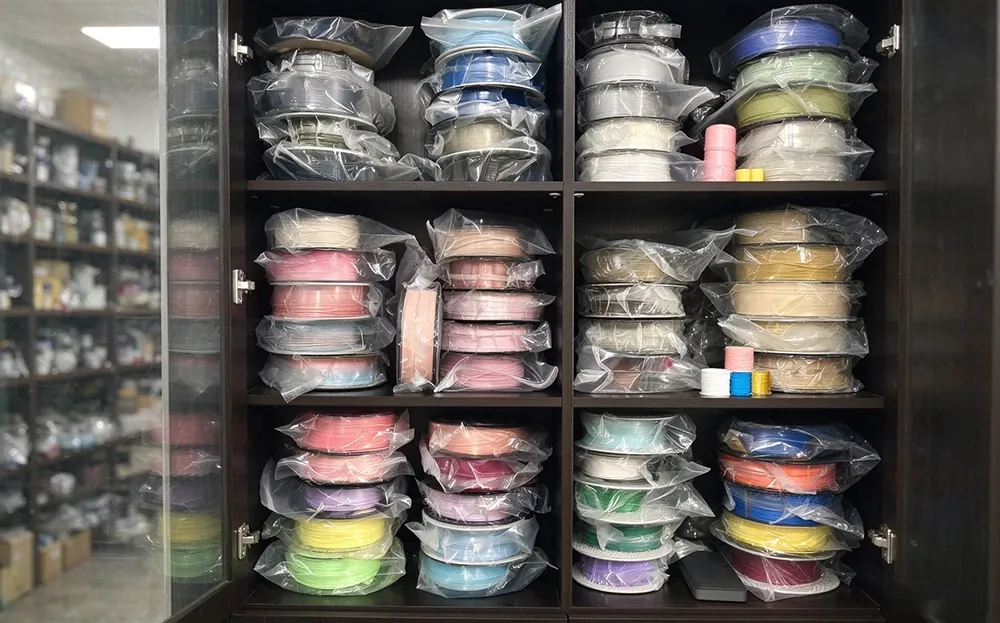
There is no single expiration date for 3D printer filament. Sealed PLA can remain usable for a long time, while moisture-sensitive nylon or TPU may deteriorate in a humid room within weeks. Dry storage and print testing matter more than the calendar.
Material comparison data
| Material | Density | Water absorption | Data status |
|---|---|---|---|
| PLA | 1.25 ±0.05 g/cm³ | 0.5% | Complete |
| ABS | 1.04 ±0.5 g/cm³ as supplied | 1% | Partial / verify |
Source: PIBUNO project material workbook and existing product templates. “Not supplied” means the project did not include a verified value; it is not an industry default.
What changes with age
Filament can absorb moisture, become brittle, fade, collect dust or change diameter. The plastic itself may also degrade after repeated heat or poor storage.
Material differences
| Material | Practical storage concern |
|---|---|
| PLA | Heat, moisture and impact brittleness |
| PETG | Moisture and clear-part appearance |
| TPU | Moisture and softness |
| ABS and ASA | Moisture, heat and storage damage |
| Nylon / PA | High moisture sensitivity |
| PC and PEEK | Follow supplier conditions |
Signs filament is no longer good
Look for:
- Popping at the nozzle
- Brittle coils
- Rough walls
- Weak layer bonding
- Inconsistent extrusion
- Color change or contamination
Dry the spool first if those symptoms match moisture. If the strand remains brittle after drying, the material may be damaged.
Test the actual spool
The drying guide explains how to check moisture. Print a small coupon with known settings and compare it with a fresh reference.
Storage practices
Use a sealed box, fresh desiccant and a humidity meter. Keep spools out of heat and sunlight. Label opening dates when running production.
The filament storage guide provides a practical setup.
Product links
See PLA, PETG and TPU for material-specific starting points.
Use a simple batch system
Write the date a spool is opened on a removable label. Keep the original product label nearby so the material and color remain identifiable.
For production, use the oldest compatible spool first. This avoids finding a forgotten roll after several seasons of humidity changes.
Separate wet from damaged material
A dry test can tell you whether moisture was the problem. If a heated drying cycle improves flow and finish, the material was likely wet.
If the strand snaps repeatedly or the color has changed, mark the spool for review. Do not mix it with an approved production lot.
Check before a large print
Print a small part with the stored spool and one with a fresh reference. Compare the surface, layer bonding and dimensional result.
The test takes less time than a failed production print and gives the operator a clear decision.
Separate shelf life from print life
A sealed spool may remain usable for a long time, while an opened spool in a humid room can change quickly.
The condition of the plastic, packaging, storage and handling matters more than a single date. Record the opening date and storage location.
Material comparison
| Material | Main risk |
|---|---|
| PLA | Heat, moisture and brittle aging |
| PETG | Moisture and surface defects |
| TPU | Moisture and feed instability |
| ABS / ASA | Moisture, heat and spool damage |
| Nylon / PA | Rapid moisture absorption |
| PEEK / PEI | Supplier-specific conditioning |
Check the spool
Inspect for loose winding, cracks, contamination and a damaged reel. A clean, dry spool can still fail if the diameter varies or the filament path is wrong.
Weigh an unused spool if the net weight is important. Record the result with the lot.
Test before disposal
Print a small reference coupon. If the result improves after drying, preserve the spool and track its storage.
If the strand stays brittle or the surface changes after drying, do not use it for critical parts. The material may have degraded beyond a moisture problem.
Keep a sample library
Store one approved print for each important material and color. It helps compare a new spool with a known result, especially when a product has a visible surface.
Use dates as one input
An opening date helps prioritize older spools, but it does not prove the material is wet or degraded.
Combine the date with storage readings and a printed test. Replace the spool when repeated drying does not recover performance.
Check the packaging
Inspect the seal, spool and label before storage. A damaged spool can create feed problems unrelated to polymer age.
Keep the original product identification with the reel. An unlabeled material is difficult to recycle or approve.
Know the exception
If a new material has a supplier-defined shelf life or conditioning requirement, follow that instruction. The general discussion is not a substitute for a product-specific limit.
Plan a replacement point
Set a review point for high-value or moisture-sensitive material. Check appearance, drying response and a test print before a large order.
Do not use an old spool for a customer part solely because it still feeds. The surface and layer bonding can change without an obvious tangle.
Archive material identity
Keep the original label, opening date and storage result. This supports traceability and makes future shelf-life decisions less arbitrary.
Review the spool after drying
Inspect the surface, diameter and winding. If the spool deforms or the filament changes shape, the storage or drying process was too aggressive.
Use a fresh reference when the result is unclear.
Store by risk
Keep nylon and moisture-sensitive composites in the most controlled storage. Give ordinary PLA a clean, shaded place.
The storage method should match the cost of failure and the sensitivity of the material.
Set a reorder point
Do not wait until a spool fails during production. Maintain an approved sealed spare for critical materials.
Check the spare at a planned interval and replace it if repeated drying no longer restores performance.
Compare a suspicious spool
Print the same coupon with the suspect and reference spools. Use the same printer and profile.
Keep the images and measurements with the material label.
Use a replacement threshold
Set a point where the spool is removed from customer work. Continue to use it only for non-critical tests if it still feeds.
This prevents uncertainty from entering a production order.
Check the desiccant
A wet spool placed beside exhausted desiccant will not stay dry. Replace the desiccant and confirm the container seal.
Inspect the product, not only the spool
A stored spool can feed normally and still produce weak, rough or discolored parts. Print the actual application when the risk is high.
Compare the result with the retained approved sample.
Record replacement decisions
Write why a spool was removed from production. This helps improve the storage routine and avoids using the same damaged lot again.
Keep a replacement record
Note the old lot, new lot and test result when a spool is replaced. This separates material aging from a printer change.
The approved profile should travel with the new material.
Set a replacement rule
Replace a spool when drying no longer restores the expected print, the strand remains brittle or the surface changes.
Keep the new spool under the same storage routine so the comparison remains useful.
Store the reference with the result
Keep a small approved print beside the material label and opening date. This gives the next operator a physical comparison instead of a memory of how the part used to look.
When a spool is replaced, record whether the old part showed moisture, brittleness or a change after drying. Those notes help improve the storage rule.
Set a documented replacement point
Replace a production spool when the approved test no longer passes after drying. Record the material lot and the observed defect.
Keep the replacement test with the new spool so the material history remains clear.
Do not use an uncertain spool for a paid batch whose appearance or strength has not been approved.
Keep a test sample for each lot
Store a small print and the opening date with the spool. The sample makes a later color, surface or layer-bonding change easier to see.
Record the spool decision
Write the date, observed condition and test result when a spool is retired. That record helps the team improve storage instead of guessing.
Replace an uncertain spool before it reaches a customer job.
Use the retained sample and the new test together to decide whether the material is still suitable.
Do not use the calendar as the only test. A dry, well-stored spool and a wet spool opened on the same day can perform differently.
Use the printed part as the final check
A spool can feed smoothly and still produce a weaker or rougher part. Compare the product with the retained sample before using the material for a customer order.
Keep the product comparison
Print a small product-shaped sample when the material has been stored for a long time. Compare extrusion, surface and dimensions with the approved reference.
If the result differs, do not use the spool for a customer batch until the cause is resolved.
FAQ
Does PLA go bad?
PLA can become brittle or absorb moisture, but sealed, dry storage helps. Test the spool before using it for a critical part.
Does PETG expire?
PETG does not have one universal expiry date. Moisture, heat and storage conditions matter.
Can old filament be dried and reused?
Often yes if it is only wet. Drying cannot restore chemically degraded or contaminated material.
How can I tell whether filament is wet?
Look for popping, rough extrusion, weak layers and unstable flow. Dry a sample and compare prints.