

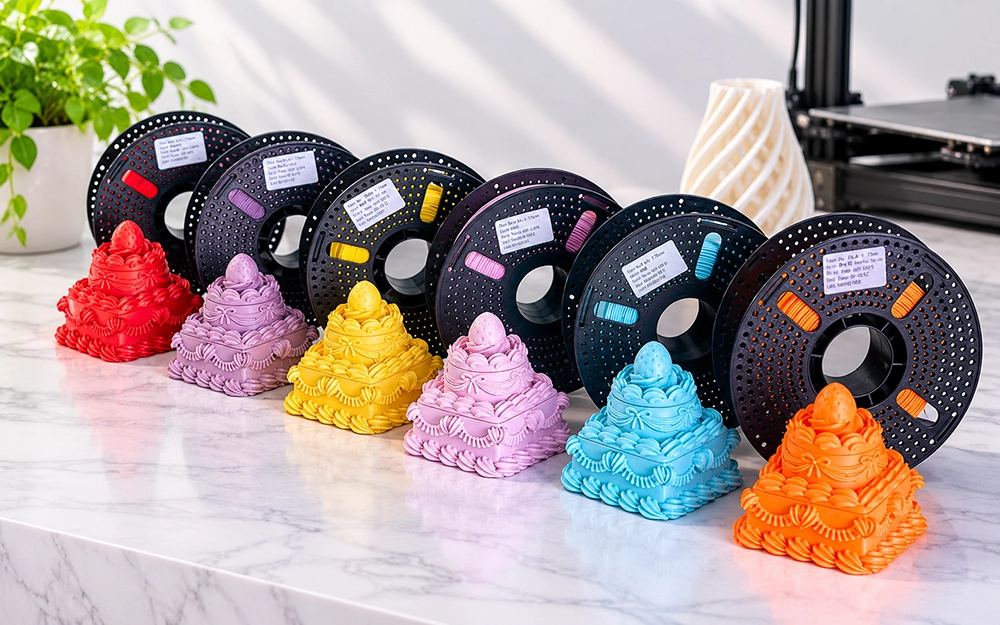
The best PLA depends on the finish, print speed, strength, and appearance you need. Standard PLA works for general models, high-speed PLA+ suits fast production, matte PLA reduces glare, silk PLA emphasizes gloss, and carbon-fiber PLA is for stiffness rather than decoration. Confirm the exact grade before comparing numbers or quoting a part.
Material comparison data
| Material | Diameter | Density | Nozzle | Bed | Print speed | Key mechanical data |
|---|---|---|---|---|---|---|
| PLA | 1.75 mm | 1.25 ±0.05 g/cm³ | 195–230°C | 0–60°C | 40–60 mm/s | Tensile 60 MPa; Elongation 3.0%; Flexural 1,900 MPa |
| PLA+ | 1.75 ±0.02 mm | 1.25 g/cm³ | 200–230°C | 45–65°C | 200–400 mm/s | Not supplied |
| Matte PLA | 1.75 mm | 1.27 g/cm³ | 200–230°C | 60–80°C | 50–200 mm/s | Flexural 2,400 MPa |
| Silk PLA | 1.75 mm | 1.25 g/cm³ | 220–230°C | 40–60°C | 50–60 mm/s | Flexural 2,060–2,160 MPa |
| PLA-CF | 1.75 mm | 1.24 g/cm³ | 200–220°C | 60–80°C | 50–200 mm/s | Flexural 2,443 MPa |
Source: PIBUNO project material workbook and existing product templates. “Not supplied” means the project did not include a verified value; it is not an industry default.
PLA grade selection
The word PLA covers several product directions with different additives and processing profiles. A standard PLA, a matte PLA, and a carbon-fiber PLA may share a base polymer, but the pigments, fillers, and modifiers change flow, surface, and mechanical behavior.
Use the application first:
- Detailed visual models usually start with standard PLA.
- High-volume printing can start with high-speed PLA+.
- Low-glare product surfaces can use matte PLA.
- Reflective decorative parts can use silk PLA.
- Natural-looking display pieces can use wood or marble PLA.
- Stiff technical prototypes can use carbon-fiber PLA.
The Pibuno PLA range covers standard and effect options, while the high-speed filament category covers faster profiles.
Use the same comparison basis
Filament comparisons often mix data from different specimen types. A tensile value from a molded bar is not the same as the strength of a printed part with layer boundaries. A maximum print speed is not a promise that the same hot end can sustain that flow.
For a purchasing decision, compare:
- Filament diameter and tolerance
- Density
- Nozzle and bed range
- Recommended layer height
- Print speed and printer requirements
- Mechanical data and test condition
- Color and surface approval
The table below uses the values available in the current PIBUNO project materials. “Not supplied” is treated as a data gap, not as an industry value.
Standard PLA: the general-purpose starting point
Standard PLA is usually the easiest reference for models, signs, prototypes, and visual parts. The supplied PIBUNO data lists 1.75 mm diameter, ±0.03 mm tolerance, 1.25 ±0.05 g/cm³ density, 195–230°C nozzle, 0–60°C bed, and 40–60 mm/s print speed.
The reported mechanical values are 60 MPa tensile strength, 3.0% elongation at break, and 1,900 MPa flexural modulus. These values describe the supplied grade under its stated conditions. They do not make every printed PLA part equally strong.
Use the PLA printing temperature guide to tune the actual spool. Start with a first-layer patch and a temperature test, then print a representative model.
Standard PLA is a poor first choice for hot cars, direct sun, or a sustained load near its heat limit. For those parts, compare PETG or an engineering material.
High-speed PLA+
High-speed PLA+ is positioned for faster printers and repeat workflows. The supplied template lists 1.75 ±0.02 mm diameter, 1.25 g/cm³ density, 200–230°C nozzle, 45–65°C bed, 0.1–0.2 mm layer height, and 200–400 mm/s print speed.
The source profile also gives a flow ratio of 0.95–0.98 and a maximum volumetric speed of 12 mm³/s. The 200–400 mm/s range only applies when the hot end, cooling, firmware, and profile can support it.
Do not select high-speed PLA solely because the upper speed looks impressive. Print a long wall and a representative part. Check layer bonding, corner quality, and extrusion consistency after the first few minutes.
Matte PLA
Matte PLA produces a low-gloss surface and can make layer reflections less obvious. The supplied reference uses 1.27 g/cm³ density, 200–230°C nozzle, 60–80°C bed, 50–200 mm/s speed, and 2,400 MPa flexural modulus.
The higher bed range and density belong to the matte product, not necessarily every standard PLA. Confirm the exact spool instruction before sharing settings.
Matte finishes are useful for product housings, display pieces, and parts that should not reflect bright highlights. Test support removal because a mark may still be visible even with low gloss.
Silk PLA
Silk PLA is selected for reflective decorative surfaces. The supplied silk reference uses 1.25 g/cm³ density, 220–230°C nozzle, 40–60°C bed, 50–60 mm/s speed, and 2,060–2,160 MPa flexural modulus.
Rainbow silk adds a changing color sequence, with an approximate change interval of 7–10 m in the supplied reference. The visible band spacing depends on the model and layer use, so print a representative object before approving a color layout.
Silk remains a PLA-based material. Its heat and outdoor limitations do not disappear because the surface looks premium.
Wood and marble PLA
Wood-effect PLA and marble-effect PLA are visual materials. The supplied wood reference lists 1.25 g/cm³ density, 200–230°C nozzle, 40–60°C bed, 50–200 mm/s speed, and 2,443 MPa flexural modulus.
The marble reference lists 1.24 g/cm³ density, the same 200–230°C nozzle range, 40–60°C bed, and 2,443 MPa flexural modulus. The two products can share a test direction while producing very different surfaces.
Approve the physical finish under final lighting. A wood or stone pattern depends on print orientation, layer height, and the exact color batch.
Glow PLA
Glow PLA combines visual effects with a familiar PLA print range. The supplied reference lists 1.25 g/cm³ density, 195–230°C nozzle, 0–60°C bed, 40–200 mm/s speed, 0.1–0.2 mm layer height, 60 MPa tensile strength, 3.0% elongation, 1,900 MPa flexural modulus, and 0.5% water absorption.
The source includes a 70–80°C bed reference for a lattice platform. Treat that as a platform-specific instruction, not a universal bed temperature.
Carbon-fiber PLA
Carbon-fiber PLA should be evaluated for stiffness and process requirements. The supplied reference lists 1.24 g/cm³ density, 1.75 mm diameter, ±0.02 mm tolerance, 200–220°C nozzle, 60–80°C bed, and 50–200 mm/s speed. The paper label lists a broader 195–230°C nozzle range.
The 2,443 MPa flexural modulus is higher than the standard PLA reference, but stiffness is not the same as impact toughness. Use a hardened nozzle and validate the real print orientation.
See the carbon-fiber filament guide before treating a reinforced PLA as an engineering substitute.
Match the grade to the part
Use this decision rule:
- Choose detail and low material cost: standard PLA.
- Choose speed on a compatible printer: high-speed PLA+.
- Choose low glare: matte PLA.
- Choose glossy decoration: silk PLA.
- Choose natural visual effects: wood or marble PLA.
- Choose novelty lighting effects: glow PLA.
- Choose stiff technical appearance: carbon-fiber PLA.
The grade still needs a printing and handling test. The data narrows the list; it does not replace a sample.
Check printability before price
A lower-cost spool is not useful if it cannot hold diameter or feed consistently. Check the spool label, net weight, tolerance, winding, and the printer's holder clearance.
For high-speed materials, verify the maximum volumetric flow of the printer. For effect and reinforced products, test the nozzle and cooling behavior. For wood, marble, and glow products, inspect visible surface variation before a customer run.
A practical sample test
Print the same small product model in two or three candidate grades. Record:
- Material, color, and lot
- Diameter
- Nozzle and bed temperature
- Print speed and flow
- Layer height and cooling
- Surface result
- Dimensions
- Load or heat result
Keep the approved sample with the spool and slicer file. A photo alone does not capture gloss, surface texture, or a failed layer bond.
Common mistakes
Do not compare standard PLA with reinforced PLA using only tensile values. Do not use a high-speed profile on a printer that cannot sustain the flow. Do not approve silk or wood color from a product photo. Do not assume every PLA product has the same density or bed range.
The PLA vs PETG guide helps when the part may need more toughness than PLA can provide.
FAQ
Is standard PLA the strongest PLA?
No. Standard PLA is stiff, while carbon-fiber PLA can have a higher flexural modulus. Strength still depends on geometry, layer direction, and the printed profile.
Is high-speed PLA always better?
No. It is useful only when the printer and profile support high flow. A standard PLA may be more predictable on an older machine.
Is silk PLA suitable for functional parts?
Silk PLA is usually selected for appearance. Test strength and heat behavior if the part also carries a load.
Does carbon-fiber PLA replace nylon or PC?
No. The base resin determines much of the heat and impact behavior. Carbon-fiber PLA is a different material family from PA-CF or PC.
Set the approval criteria
Write down what the customer will judge first: color, gloss, dimensional fit, print time, stiffness, or impact. The same PLA family can be a good choice for one of those needs and a poor choice for another.
For a retail display, approve a physical sample under the final light. For a functional bracket, test the production orientation and the expected load. For a high-speed print farm, compare cycle time and reject rate rather than the maximum speed printed on the product page.
Check the spool as part of the product
Inspect the diameter, tolerance, net weight, and winding before a batch. The spool must fit the printer and dry box. A good filament that does not feed from the installed holder is not a production-ready choice.
Keep the approved spool label with the sample. A future color, additive, or grade change should trigger a new test.
Compare total cost
Price per kilogram is not the same as cost per accepted part. Include failed starts, purge, support, spool changes, and operator time.
High-speed PLA+ may reduce machine time, but only when the printer can sustain the flow. A lower-speed standard PLA can be more economical when the machine is not ready for high-speed production.