

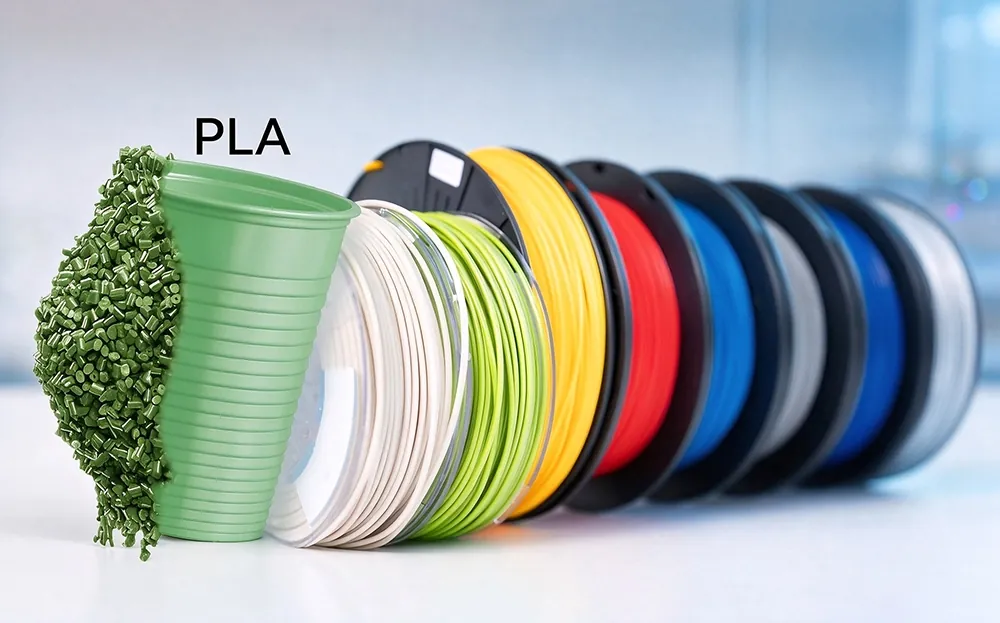
PLA is biodegradable under specific industrial composting conditions, not automatically in a home compost bin, garden or landfill. The printed part, material additives and local waste system affect what happens after use.
PIBUNO material data
| Parameter | PIBUNO supplied value |
|---|---|
| Material | PLA |
| Grade / effect | Standard PLA |
| Diameter | 1.75 mm |
| Diameter tolerance | ±0.03 mm |
| Net weight | 1 kg/spool |
| Density | 1.25 ±0.05 g/cm³ |
| Nozzle | 195–230°C |
| Bed | 0–60°C |
| Print speed | 40–60 mm/s |
| Layer height | 0.1–0.2 mm |
| Tensile strength | 60 MPa |
| Elongation at break | 3.0% |
| Flexural modulus | 1,900 MPa |
| Water absorption | 0.5% |
| Melt flow | 3–7 g/10 min at 190°C, 2.16 kg |
| Data status | Complete |
| Source note | Use 70–80°C bed only for the lattice-platform reference stated in the source. |
Source: PIBUNO project material workbook and existing product templates. “Not supplied” means the project did not include a verified value; it is not an industry default.
What biodegradable means
Biodegradation depends on temperature, moisture, oxygen and microorganisms. Industrial composting can maintain different conditions from an ordinary backyard pile.
A product labeled as compostable should state the standard and disposal environment. A generic “biodegradable” claim is not enough.
Why a 3D print may last
The finished part is solid plastic. Its shape, thickness and surface reduce the chance of rapid breakdown in an uncontrolled environment.
Colorants and additives may also affect the process. Check the exact product documentation.
Recycling versus composting
Recycling keeps the material in a manufacturing loop when a suitable collection stream exists. Composting breaks the material down under controlled conditions.
The filament recycling guide explains sorting and reprocessing.
Product design
Use less material where the design allows, avoid unnecessary mixed materials and label the plastic type. A clean waste stream is easier to recycle or process.
Brand and material pages
See the Pibuno PLA category, filament types guide and product catalog for material context.
Ask for evidence
A compostability or biodegradation claim should identify the standard, test condition and material grade. Ask whether the claim applies to the raw material, the colored filament or a finished printed part.
The answer may be narrower than the marketing phrase. For example, a material can meet an industrial composting standard while being unsuitable for home composting.
Use affects disposal
A thin test coupon may break down differently from a thick solid product. Contamination, coatings, inserts and mixed-material assemblies also change the end-of-life path.
If a customer needs a product with a credible waste strategy, design for separation and material identification from the start.
Avoid broad environmental claims
“Biodegradable” is not the same as “safe to leave outdoors.” It also does not answer whether the product can be recycled where the customer lives.
Use specific language and keep supporting documents available for buyers who review the product.
What composting conditions mean
Industrial composting controls temperature, moisture, oxygen and microbial activity. A home garden does not reproduce those conditions.
A material can meet one composting standard and still remain intact in a landfill or a dry outdoor setting. The disposal route matters.
PLA products are not all identical
Colorants, additives and blends can change the end-of-life behavior. Ask what the supplier's claim covers: the raw polymer, the colored filament or a finished printed product.
Design for material recovery
Avoid permanently bonding different plastics when recycling is a goal. Label the material and keep support or purge waste separated.
Choose the right claim
Use “industrially compostable under [specified standard]” only when the exact product and supporting evidence allow it. For other cases, explain the uncertainty and the available disposal route.
Compare with recycling
Mechanical recycling can keep clean plastic in use. Composting may be appropriate for a specific certified product and collection system.
Both options require collection and sorting. A material choice alone does not create a circular system.
Plan for end of life
At the design stage, decide whether the part can be disassembled, recycled or sent to an appropriate organic-waste route.
Mixed materials and permanent inserts make material recovery harder. Label the plastic and avoid unnecessary coatings.
Check local infrastructure
A claim accepted in one region may not match the collection service where the product is sold.
Ask whether industrial composting is available, what contamination rules apply and whether the printed part is accepted.
Talk to customers accurately
Explain the difference between the raw material and the finished item. Avoid implying that a discarded print disappears in any environment.
For a product claim, keep the standard, test conditions and collection instructions together.
Use recycling first when practical
Clean, identified scrap may be more valuable in a mechanical recycling stream than in an inappropriate compost bin.
The recycling guide explains material sorting and output testing.
Keep the wording specific
A safe statement might identify industrial composting, the relevant standard and the collection condition.
A broad “eco-friendly” statement can mislead if no collection route exists. Marketing should match the actual evidence.
Consider product longevity
A durable part that stays in use can reduce replacement waste even if it is not compostable. Choose the disposal story after defining the product life.
Verify the exact product
Colorants, blends and coatings can change the claim. Ask for the specification of the finished material, not only the base polymer.
Design an honest disposal guide
Tell the customer what evidence exists and where the product can be processed. If no route exists, do not imply that the item can be composted at home.
Compare the product life
A reusable part may avoid more waste than a disposable part with a compostable label. Material selection should consider use, replacement and actual collection.
Document the material
Keep the exact PLA grade and color. A general family claim may not cover a blend or additive.
Use packaging to communicate
Provide disposal instructions only if they match the local system and the exact material. Avoid a compost symbol without supporting evidence.
Check the whole product
Adhesive, paint and mixed inserts can change the waste route. The finished article may not be compostable even when the filament base is.
Document those materials during design.
Keep claims tied to evidence
State whether the claim covers the polymer, a specific finished product or a test result. Name the disposal condition when the evidence supports it.
Check local availability
No collection route means no practical composting path for the customer. Include this limit in the article and the product guidance.
Ask what happened after disposal
A certification can describe a test environment. It does not prove that a customer has access to that environment.
State the required collection route and the evidence available for the exact material.
Keep a material record
The article should distinguish PLA filament from the finished part. Colorants, additives and mixed components can change the waste decision.
Keep the claim narrow
State the exact material, test condition and available disposal route. If the evidence covers only the polymer, do not extend the claim to a mixed finished product.
Use a disposal route that exists
Industrial composting requires collection and controlled processing. If that route is unavailable, the product should not be marketed as practically compostable.
Keep the disposal statement specific
The exact material, standard and available collection route should appear together. A broad environmental claim can create expectations the waste system cannot meet.
The phrase should identify whether it describes the filament, the printed product or only a laboratory condition.
Avoid greenwashing
If no collection route exists, describe the limitation. A recyclable or compostable material cannot solve waste without an actual process.
Use the most specific verified statement the evidence supports.
Keep the disposal claim narrow
Name the tested material and the available collection route. Do not imply that an ordinary landfill or backyard pile provides industrial composting conditions.
Record the claim and its limit
Keep the exact material, test standard and available disposal route together. A claim without a practical route does not tell the customer what to do with the product.
When the exact product is not covered, state that limitation rather than extending the raw-material claim.
The final product and its packaging should give the customer a realistic disposal option.
Keep the claim practical
State the exact material and disposal route. If the route is unavailable, do not imply that ordinary disposal will make the part disappear.
Compare the claim with the full product
The raw filament, printed part and packaging may follow different waste routes. State which item the evidence covers and what the customer can actually do with it.
For product design, separate removable components and identify the polymer. A clean material stream is more useful than a mixed assembly with a compostability statement.
Use recycling or industrial composting only when a real collection route exists.
The product guidance should tell the customer what to do next instead of ending with an unverified environmental claim.
Make the disposal instruction useful
A customer needs to know whether the item goes to recycling, industrial composting or general waste. If that route is unverified, say so.
The claimed disposal route and the exact product should appear together.
If the product includes other materials, list them before making a compostability statement.
The customer should be able to identify where the item can actually be sent.
This avoids confusing a material property with an available service.
The product guidance should make that distinction clear before the customer disposes of the item.
FAQ
Does PLA decompose in a landfill?
Do not assume it decomposes quickly. Landfill conditions are not the same as industrial composting.
Is PLA compostable at home?
Some industrial-compostable products require controlled heat. Check the material and local composting provider.
Does pigment affect biodegradation?
It may. Use the manufacturer's documentation for the exact color and grade.
Is biodegradable the same as recyclable?
No. Recycling reprocesses material; composting breaks it down under defined conditions.