

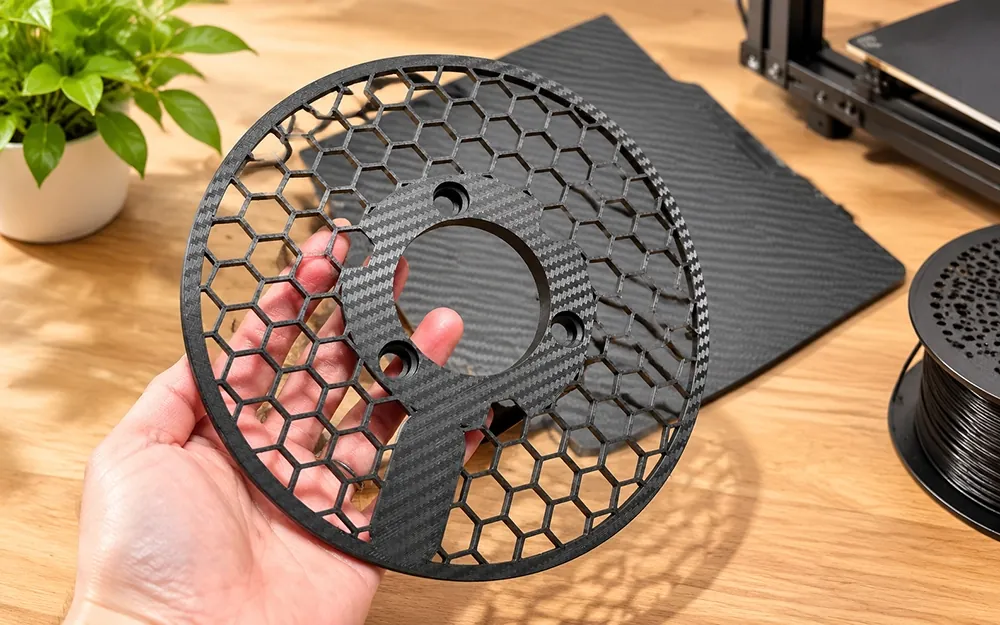
Carbon-fiber filament is a base plastic reinforced with short carbon fibers. The base resin controls much of the heat and impact behavior; the fibers increase stiffness and require a wear-resistant nozzle.
PIBUNO material data
| Parameter | PIBUNO supplied value |
|---|---|
| Material | PLA-CF |
| Grade / effect | Carbon-fiber reinforced PLA |
| Diameter | 1.75 mm |
| Diameter tolerance | ±0.02 mm |
| Net weight | 1 kg/spool |
| Density | 1.24 g/cm³ |
| Nozzle | 200–220°C |
| Bed | 60–80°C |
| Print speed | 50–200 mm/s |
| Flexural modulus | 2,443 MPa |
| Data status | Partial |
| Source note | Paper-label nozzle range in source: 195–230°C. Use a wear-resistant nozzle. |
Source: PIBUNO project material workbook and existing product templates. “Not supplied” means the project did not include a verified value; it is not an industry default.
What changes when carbon fiber is added
Short fibers can raise stiffness and improve dimensional stability. They can also reduce impact toughness if the base resin is brittle or the print profile creates weak layer bonds.
The word “carbon fiber” does not describe the whole material. PLA-CF, PETG-CF, PA-CF and other composites have different heat, strength and moisture requirements.
Compare the base resin first
| Material | Best starting use | Main check |
|---|---|---|
| PLA-CF | Stiff models and display prototypes | Heat and impact limits |
| PETG-CF | Technical covers and fixtures | Nozzle wear and layer bonding |
| PA-CF | Tough structural parts | Drying and printer capability |
Choose the base polymer for the application, then use the fibers for added stiffness.
Plan for nozzle wear
Abrasive fibers can wear a brass nozzle. Use the nozzle material recommended for the filament, often a hardened steel or other wear-resistant option.
Inspect the nozzle and extruder after long runs. Wear can change the hole size and flow. A rising extrusion multiplier may be a symptom rather than a solution.
Dry the material
Nylon-based composites can absorb moisture quickly. Dry them according to the supplier's instructions and keep them in a sealed container during production.
Signs of moisture include popping, rough surfaces and weak extrusion. Do not tune around these symptoms with temperature alone.
Print settings to validate
Use the material maker's starting profile, then check:
- Nozzle temperature
- Flow and volumetric limit
- Layer height
- Cooling
- Retraction
- Nozzle material
CF blends can be more abrasive and slightly more viscous than the base polymer. A profile copied from standard PLA may under-extrude.
Design for layer direction
Short-fiber reinforcement does not make a printed part isotropic. Layers remain a potential weak plane.
Orient the part so the main load crosses layers in a useful direction. Add ribs and fillets where a sharp corner would concentrate stress. Test the actual printed orientation rather than a solid material specimen.
Applications
CF blends can suit:
- Jigs and fixtures
- Drone and RC components
- Lightweight brackets
- Technical enclosures
- Display parts with a matte technical finish
Pibuno's carbon fiber filament category and engineering filament category provide product starting points.
The filament types guide explains where reinforced materials fit in the wider range.
Strength versus stiffness
A part can be stiff and still fail under impact. Carbon fiber often increases stiffness, but the base resin and layer adhesion determine whether the part can absorb energy.
If the failure mode is bending, a stiffer material may help. If the failure mode is a crack from a sudden hit, a tougher nylon or polycarbonate may be a better starting point.
Production checks
Before a batch:
- Dry the spool.
- Confirm nozzle compatibility.
- Print a representative geometry.
- Measure critical dimensions.
- Apply the expected load.
- Inspect the nozzle and print surface after the run.
Keep the approved material, color, profile and batch together.
What the fiber content does not tell you
A percentage of carbon fiber does not identify the finished composite. The fiber length, orientation, sizing and distribution matter, and so does the polymer around them.
Short fibers in a filament are usually oriented by flow through the nozzle. That means the finished part can behave differently from a molded specimen.
Ask for data on the exact printed specimen when a structural claim matters. A material data sheet for a molded bar may not predict a layered printed bracket.
Base-resin selection
PLA-CF can be useful for stiff prototypes that do not see high heat. PETG-CF may balance stiffness with more toughness and moderate heat performance. PA-CF can support demanding structural parts, but the nylon base makes drying critical.
The PLA material page and PETG material page help compare the unfilled families. Use the engineering category when the requirement extends beyond those materials.
Printer hardware
Carbon-fiber blends can wear brass nozzles. A hardened nozzle reduces wear, but it does not remove the need to inspect the extrusion system.
Check the feeder gears, PTFE path and nozzle after long production. A worn nozzle can increase the hole size and change the printed line width.
Some composites also need a larger nozzle to reduce clogging risk. Follow the exact supplier recommendation rather than choosing a diameter from appearance alone.
Flow and temperature
The fibers can make the melt more viscous. A profile copied from unfilled PLA or PETG may under-extrude.
Start with the supplier range and print a flow coupon. Inspect the top surface, wall thickness and layer bonding. Raise temperature only when the material recommendation supports it.
Higher temperature can improve flow while increasing stringing or softening detail. Keep the change measured and record the resulting surface.
Layer direction is a design input
The reinforcement can increase stiffness along the printed bead, but the bond between layers remains a possible failure plane.
For a bracket, identify the main tensile, bending and impact directions. Orient the part so the highest load does not pull layers directly apart.
Add ribs where stiffness matters. Round interior corners and use a fastener washer when a screw clamps the plastic.
Moisture and drying
PA-CF and other nylon-based blends can absorb moisture quickly. Dry the spool using the exact supplier instruction and protect it during printing.
Popping, foaming and rough walls indicate a process problem that may be moisture. Test a dry reference before changing the profile.
Applications where the material helps
CF blends are useful for:
- Jigs that need stiffness
- Lightweight fixtures
- Technical-looking housings
- Drone and RC components
- Prototypes that need reduced deflection
They are less suitable when low cost, high impact toughness or simple processing is the main requirement.
Production approval
Keep:
- Exact material and fiber type
- Color
- Nozzle specification
- Printer and profile
- Drying record
- Test geometry and load direction
- Approved physical sample
Compare a second spool or lot before a repeat order. A new fiber source or base polymer can change appearance and print behavior.
Understand anisotropy
The printed bead can be stronger along its length than across the bond to the previous layer. Carbon fibers may align with the extrusion path, so reinforcement is direction-dependent.
For a load-bearing part, mark the load direction on the drawing or test plan. Rotate the model in the slicer and compare both samples before approving the orientation.
Surface and wear
CF prints often show a matte, slightly textured surface. The exact appearance varies with fiber content, pigment and layer height.
The same abrasive material that improves stiffness can wear a brass nozzle, a feeder gear or a soft guide. Inspect these parts as a system.
Compare strength claims
A tensile value from a molded specimen does not automatically apply to a layered print. Ask whether the data refers to:
- Raw filament
- Molded test bars
- Printed bars
- A specific print orientation
- A conditioned or dry specimen
Record the difference. Mixing those conditions can make a material look stronger than the actual part.
A sample approval plan
Use one production-like bracket with a hole, a thin wall and a load arm. Print it in the intended direction and test it under the expected condition.
Keep the failed sample if one exists. A fracture surface shows whether the part broke through layers or outside the intended load path.
Additive cost versus value
CF material can cost more and may require a hardened nozzle and slower validation. It can still be the right choice when reduced deflection or a technical finish matters.
If the part only needs visual appearance, choose an effect material. If it needs impact toughness, compare a tough unfilled polymer. The material should solve the dominant requirement.
Document the fiber and finish
Record the fiber type, base polymer, color and nozzle in the product specification. A buyer asking for “carbon fiber” may mean a matte decorative finish, a PA-CF structural blend or another composite entirely.
Keep the spool label and approved print sample together so the next order can be checked against the same material direction. Different fiber loading can change flow, stiffness and appearance.
Verify the sample before release
Inspect dimensions, surface and the loaded test area. A stiff sample can still fail at a hole or thin rib, so check those details before the material is approved for the actual product.
Keep the failed test result as well as the passing one so a future change can be judged against a known failure mode.
FAQ
Is carbon fiber filament stronger than PLA?
It can be stiffer, but strength depends on the base resin, fiber loading, layer bonding and load direction.
Do I need a hardened nozzle?
Often, yes. Abrasive fibers can wear standard nozzles. Follow the filament and printer recommendations.
Can CF filament be used outdoors?
The base resin and formulation determine weather resistance. A CF label alone does not make a material UV-resistant.
Is CF filament food safe?
No material family should be treated as food safe without documentation for the exact grade and finished-part use. The fibers and base polymer both matter.