

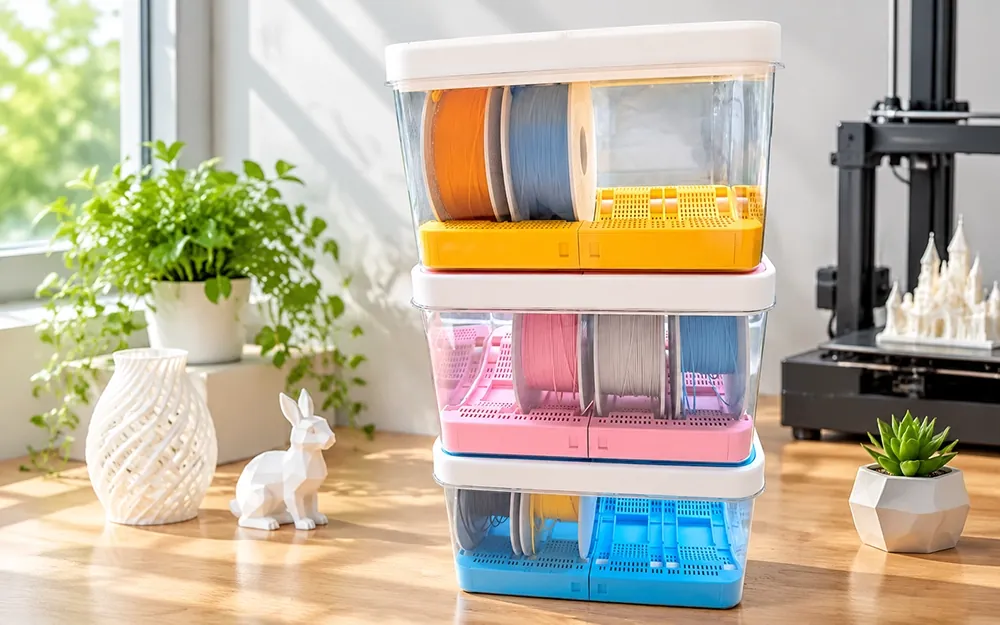
Many material profiles suggest drying PLA around 45-55 C, PETG around 60-65 C and TPU around 50-60 C for several hours. Use the filament maker's specification first and keep the dryer below the material's softening point.
Material comparison data
| Material | Density | Water absorption | Data status |
|---|---|---|---|
| PLA | 1.25 ±0.05 g/cm³ | 0.5% | Complete |
| ABS | 1.04 ±0.5 g/cm³ as supplied | 1% | Partial / verify |
Source: PIBUNO project material workbook and existing product templates. “Not supplied” means the project did not include a verified value; it is not an industry default.
First confirm that moisture is the problem
Look for popping, steam, rough surfaces, weak layer bonding or unusual stringing. A wet spool can also produce inconsistent extrusion.
Do not assume every surface defect is moisture. Check the nozzle, first layer, temperature and material profile. A drying step cannot fix a blocked nozzle.
Use a controlled dryer
A purpose-built filament dryer is easier to control than an oven. Set the temperature, place the spool inside and allow enough time for the moisture to leave.
Use a thermometer if the dryer's display is not trustworthy. Do not exceed the maximum temperature on the spool.
A starting temperature guide
| Material | Starting drying range | Notes |
|---|---|---|
| PLA | About 45-55 C | Keep below the heat-deflection risk |
| PETG | About 60-65 C | Check the exact grade |
| TPU | About 50-60 C | Avoid overheating soft grades |
| Nylon / PA | Follow supplier data | Often more moisture-sensitive |
| PC / PEEK | Follow supplier data | Higher-temperature drying may be required |
These are ranges for planning, not universal recipes. Thick spools, wet material and humid rooms may need more time.
Oven cautions
An oven can overshoot temperature and heat the spool unevenly. Do not use a household oven unless you can verify the temperature and the material maker approves the method.
Remove cardboard or plastic components that cannot handle the heat. Do not put filament in contact with a hot element or a fan that blows uneven air.
Dry in a way you can measure
Record the start time, temperature and material. After drying, seal the spool and print a small test before a long production run.
If the defect remains, dry longer or check whether the spool is damaged. Do not keep raising the temperature.
Store after drying
Move the spool to a sealed container with desiccant. Let it cool before sealing if the container or desiccant cannot handle warm air.
The filament storage guide covers humidity, handling and material-specific storage.
When to replace a spool
Drying can remove moisture, but it cannot fix degraded or contaminated material. If the filament is brittle along the whole strand, has a changed color or repeatedly fails after drying, inspect the lot with the supplier.
For important work, keep a fresh reference spool and compare behavior.
Understand what drying changes
Drying moves water out of the polymer. It does not restore a material that has been overheated, contaminated or chemically degraded.
The rate depends on temperature, air movement, spool geometry and how much moisture has been absorbed. A dryer display shows its setpoint, not the moisture inside the filament.
A dry spool can still print badly if the nozzle is partially blocked or the profile is wrong. Use the drying result as one part of the diagnosis.
Choose a drying method
| Method | Strength | Limit |
|---|---|---|
| Purpose-built filament dryer | Controlled heat and enclosure | Confirm actual temperature |
| Heated dry box | Can feed while drying | Airflow and sensor placement |
| Oven | Some ovens have precise low heat | Overshoot and uneven heat risk |
| Desiccant only | Keeps dry material dry | Does not remove large moisture loads |
For production, a dryer with a stable setpoint and a readable thermometer is easier to audit than an improvised heat source.
Material planning table
| Material | Typical planning range | Main watch |
|---|---|---|
| PLA | About 45-55 C | Avoid heat deformation |
| PETG | About 60-65 C | Clear parts show surface defects |
| TPU | About 50-60 C | Soft reels and low-temperature limits |
| Nylon / PA | Follow exact supplier data | High moisture sensitivity |
| PC / PEEK | Follow exact supplier data | High-temperature process requirements |
| Composite blends | Follow base-resin data | Fiber does not remove moisture risk |
The table is not a substitute for the exact spool instruction.
Prepare the spool
Remove packaging that cannot tolerate the temperature. Keep the filament secured so it does not unwind.
Place the spool in a way that allows warm air to reach the filament, but do not press it against a heating element. Use the dryer maker's loading direction.
Measure and document
Record the material, color, spool lot, starting time, set temperature and dryer. After cooling, seal the spool.
Print a small test with the approved profile. Compare stringing, bubbling, walls and layer bonding with a dry reference.
Avoid over-drying
Longer is not automatically better. Excess heat can soften the spool, fuse layers or change the filament shape.
Use a known material range and stop if the spool shows deformation or a changed surface. Replace damaged filament rather than trying to print around it.
Post-drying storage
Let the spool cool inside a clean container with desiccant. If the material is extremely moisture-sensitive, dry the container environment before sealing.
Keep a date label and monitor humidity. A spool can reabsorb moisture after a successful drying cycle.
Use a comparison print
Print the same small part before and after drying. Keep the slicer profile and material unchanged so the comparison is meaningful.
Inspect the first few layers and a longer vertical wall. A wet spool may show popping early, but a partially wet spool can reveal rough bands later.
Troubleshoot a failed drying attempt
If the part does not improve, check the dryer with a separate thermometer. A display can be inaccurate.
Confirm that warm air can reach the wound filament. A tight spool on a solid platform may heat unevenly.
If the material is nylon or a composite with a moisture-sensitive base resin, use its exact supplier profile. Do not apply a PLA drying time to a different polymer.
When moisture is not the cause
Weak walls can come from a partial nozzle blockage or too little flow. Stringing can come from temperature and travel settings. A rough surface can come from over-melting or contamination.
Compare a dry reference spool. If both spools fail, move to machine and profile checks.
Keep the process repeatable
A drying record should identify the dryer, temperature, time and spool. A future operator should be able to repeat the condition that produced the approved test.
For a customer part, keep the dried spool sealed until the production run begins. Open exposure can undo a successful drying cycle.
Handle condensation
Let a warm spool cool in a sealed container before opening it in a humid room. Rapid cooling in open air can encourage condensation.
If the container is too warm for the desiccant, use a temporary sealed container and transfer the spool after it reaches room temperature.
Check the filament before heating
Inspect the spool for deformed layers, contamination and an exposed, tangled end. Dry the material only when the reel can withstand the temperature.
Use a clean dryer. Dust or residue can transfer to the filament and enter the nozzle.
Keep a simple test log
Record the appearance before drying, settings used and the result of the post-dry print. This helps distinguish moisture from a worn nozzle or a profile that changed.
Over time, the log shows which materials need a dry box and which can be stored with a shorter routine. It is more useful than applying one drying habit to every spool.
Do not dry unknown materials by guesswork
If the polymer, coating or reel material is unknown, do not choose a high temperature from another product. Identify the material or keep it separate from production.
An unknown spool cannot be approved from appearance after heating. The safe decision may be to discard it from a critical job rather than risk deformation or contamination.
Final check before a long print
Dry the spool, feed a short test, inspect the first layers and confirm that the profile is correct for the material. A long print should not be used as the first moisture test.
Store the approved spool in the same condition that produced the test. That keeps the material state connected to the successful result.
Check the filament end for contamination before loading. A clean spool and a verified profile make the next result easier to interpret.
Replace the desiccant when the indicator changes so the sealed storage remains effective after the test.
Keep the container closed between production runs.
Material pages
Pibuno provides material examples in its PLA category, PETG category and TPU category. Use the exact product instructions when available.
FAQ
Can I dry PLA in an oven?
Only with verified temperature control and a method approved by the filament maker. Household ovens can overshoot and deform the spool or filament.
How long does filament take to dry?
Several hours is common, but time depends on material, spool size, dryer and moisture level. Use the supplier's profile and verify with a test print.
Can wet filament be fixed by increasing temperature?
No. Higher temperature can introduce new defects. Dry the material and keep the print profile within the recommended range.
Does desiccant replace drying?
Desiccant helps keep dry filament dry. It is not a reliable way to remove large amounts of moisture from a wet spool.