

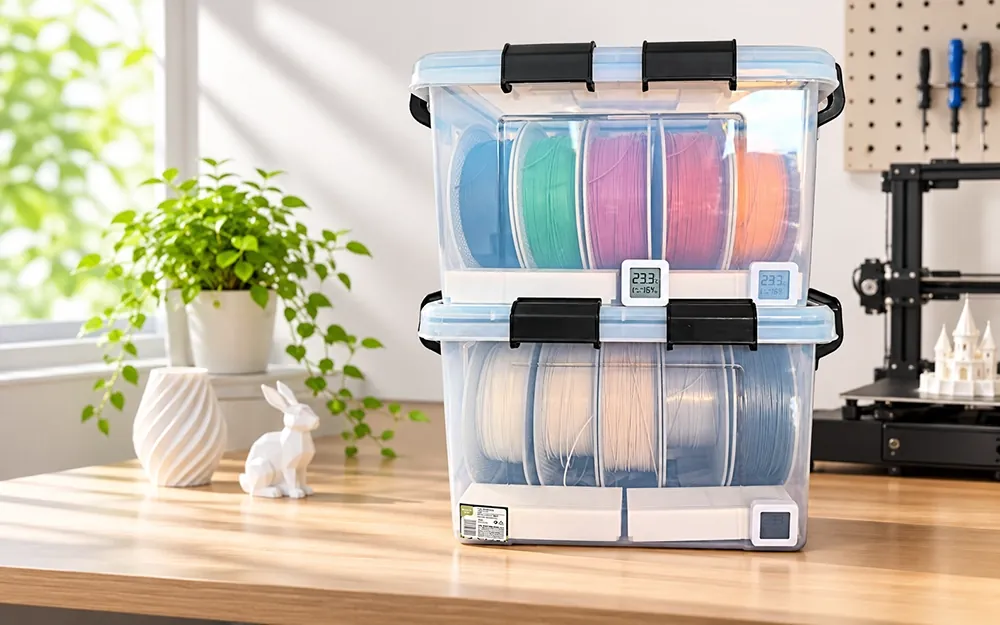
Store filament in a sealed container with fresh desiccant, keep spools out of sunlight and measure humidity instead of relying on feel. Reseal each spool after use, especially for nylon and TPU.
Material comparison data
| Material | Density | Water absorption | Data status |
|---|---|---|---|
| PLA | 1.25 ±0.05 g/cm³ | 0.5% | Complete |
| ABS | 1.04 ±0.5 g/cm³ as supplied | 1% | Partial / verify |
| TPU | Not supplied | Not supplied | Partial |
Source: PIBUNO project material workbook and existing product templates. “Not supplied” means the project did not include a verified value; it is not an industry default.
Start with the moisture problem
Most FDM plastics absorb some water from the air. The risk depends on the material, local humidity, storage time and how often the spool is exposed.
Moisture can cause:
- Popping or hissing at the nozzle
- Rough surfaces
- Weak layer bonding
- Excess stringing
- Unstable extrusion
Those symptoms can look like a temperature problem. Check storage and drying before rebuilding the entire print profile.
Use a sealed box and desiccant
A clean plastic storage box with a gasket is often enough. Add fresh desiccant and a small humidity meter.
Keep the meter inside the box so you can see whether the environment stays stable. A desiccant packet that has absorbed its capacity cannot protect the filament.
Replace or recharge desiccant according to its instructions. Record the date when possible.
Keep spools clean and supported
Do not let spools sit on a dusty floor or in direct sunlight. UV exposure can change the plastic, and dust can enter the filament path.
Store spools on a smooth surface or in a holder. Avoid stacking heavy objects on the sides, which can distort the spool and make feeding uneven.
Control the handling routine
Open the storage box only when you need a spool. Return it promptly after the print.
When changing material:
- Cut off any dirty or damaged filament end.
- Secure the end through the spool hole.
- Remove loose debris.
- Return the spool to the dry box.
Do not judge dryness by whether the filament feels wet. Condensation can happen inside a sealed bag without an obvious surface film.
Material-specific storage
| Material | Storage note |
|---|---|
| PLA | Moderate protection from moisture and heat |
| PETG | Keep dry, especially for clear parts |
| TPU | Use a sealed box and dry before critical prints |
| Nylon and PA | High moisture sensitivity; dry storage is essential |
| PC and PEEK | Follow the supplier's conditioned-storage guidance |
| Carbon-fiber blends | Store dry because the base resin may be moisture-sensitive |
The filament drying guide covers what to do when a spool has already absorbed water.
Check storage before blaming the spool
Print a small test part with a fresh spool and a stored spool from the same batch. Use the same profile and compare extrusion, surface and layer bonding.
If the stored spool performs worse, dry it and repeat. This isolates storage from material quality.
Pibuno's PETG category and TPU category explain the material families before you set up a storage routine.
Use a humidity target
A sealed box without a humidity reading can feel dry while the spool remains exposed to moisture. Add a small meter and record the reading when a spool is sealed and when it is removed.
The target depends on the material and supplier guidance. A dryer setup designed for nylon may not be necessary for a short PLA project. It may still be appropriate for a critical PETG or TPU part.
Measure the room as well as the container. A box opened in a humid room can gain moisture quickly, especially when the desiccant is exhausted.
Build the storage station
A practical station includes:
- A clean container with a seal
- Fresh desiccant
- A humidity meter
- Spool labels
- A simple opening-date log
- A separate area for unknown or damaged material
Keep the desiccant away from direct contact with the filament. Replace it according to the manufacturer or its indicator.
Avoid condensation
Moving a cold spool into a warm, humid room can create condensation. Let it reach room temperature inside a closed container before opening it.
Do not place filament next to a heater to dry quickly. Uneven heat can soften or deform the spool and alter the filament.
Handling during a print
Leave a stored spool in its dry box while printing when the setup supports it. If the printer needs the spool outside the box, keep the exposure short and reseal it afterward.
Support the spool so it turns without rubbing. A dry spool that binds on its holder can still cause poor extrusion and inconsistent layer quality.
Material-specific habits
PLA often tolerates ordinary workshop storage better than nylon, but heat and dust still matter. PETG used for clear parts should be kept dry because surface defects are more visible.
TPU can change feeding behavior after moisture absorption. Carbon-fiber blends and other composites may use a moisture-sensitive base resin, so treat the supplier's storage instruction as part of the material specification.
Audit the storage system
At the end of a production week, inspect:
- Seals for damage
- Desiccant condition
- Meter readings
- Spool labels
- Loose filament ends
- Dust and contamination
Replace failed containers and clean the station. The goal is repeatable material condition, not a shelf that looks organized.
Know when storage is not the problem
A dry spool can still produce poor parts because of nozzle wear, wrong temperature, loose belts or a bad model. Keep a known-good spool as a control.
If the reference spool prints correctly through the same equipment, test the suspect spool after drying. If both fail, inspect the printer before discarding material.
A simple moisture log
Write the material, opening date, container, desiccant replacement date and latest humidity reading on a label. This takes little space and makes an old spool easier to evaluate.
If a spool fails a test, add the drying result and whether the print improved. The log becomes evidence for the storage process rather than a list of names.
Keep unknown material separate
Unlabeled filament should not enter a production box. Its polymer and color are not known, and a mixed spool can contaminate an otherwise controlled stream.
Use a quarantine area until the material is identified. Dispose of or recycle it only through a route appropriate to the actual plastic.
Storage and material cost
Moisture failures add material, labor and machine time. A sealed container and a small amount of desiccant may cost less than one failed production part.
The best storage method depends on the scale. A single hobbyist can use a small box; a print farm needs a repeatable station with labels and inventory.
Diagnose storage problems
| Observation | What to check |
|---|---|
| Popping or hissing | Moisture in the material |
| Brittle filament | Age, heat or moisture history |
| Dust on the strand | Open storage and feed-path cleaning |
| Uneven feeding | Distorted spool, binding or tangled winding |
| Condensation | Temperature change and container seal |
| Repeated rough walls | Contamination, moisture or nozzle wear |
Treat the result as evidence. If drying improves a stored spool but a fresh spool prints normally, the storage route is the issue.
Define when to dry
Do not dry every spool by habit without checking the material. Excess or careless heat can damage the reel or soften the filament.
Use the supplier's temperature and time as the baseline. Record the result and keep the spool sealed after it cools.
For long production runs, a dry box that feeds the printer may be more practical than removing the spool for every job.
Storage for repeat orders
A repeat order should return to the same storage condition as the approved sample. If a new material requires a different box, label or desiccant procedure, write it into receiving instructions.
Check the package before it enters the storage area. A damaged seal or a spool with an exposed end should be handled as a separate inspection item.
Protect the filament end
Thread the end through the spool hole or use the manufacturer's securing method. A loose end can unwind, cross other strands and create a tangle during the next print.
Inspect the outer layer before placing the spool in service. Loose loops near the edge are easier to correct before they enter the feed system.
Review the environment
The room matters as much as the box. Avoid storage beside a hot window, a humid wall or a floor that collects water.
Keep a simple monthly check of the container and meter. A storage system that is not inspected slowly becomes an assumption.
Label in a way that survives use
Place the material and color label where it remains readable after handling. Keep a second identifier inside the dry box when the spool label is exposed to wear.
Record the label information with the lot number so a later query can be tied back to the original shipment.
FAQ
Can PLA be stored in the open?
PLA is often more forgiving than nylon, but it still benefits from dry storage. Humidity, dust and heat can affect appearance and print quality.
How long can filament stay sealed?
There is no single answer. Packaging, desiccant condition, temperature and humidity all matter. Keep the original seal and record the opening date when possible.
Should filament be stored in the refrigerator?
Low temperature is not the main goal. Condensation and moisture control are more important. Follow the material supplier's storage guidance.
When should filament be dried?
Dry it when symptoms appear, after a long humid exposure or when the material maker specifies it. Use a temperature below the material's softening point.