

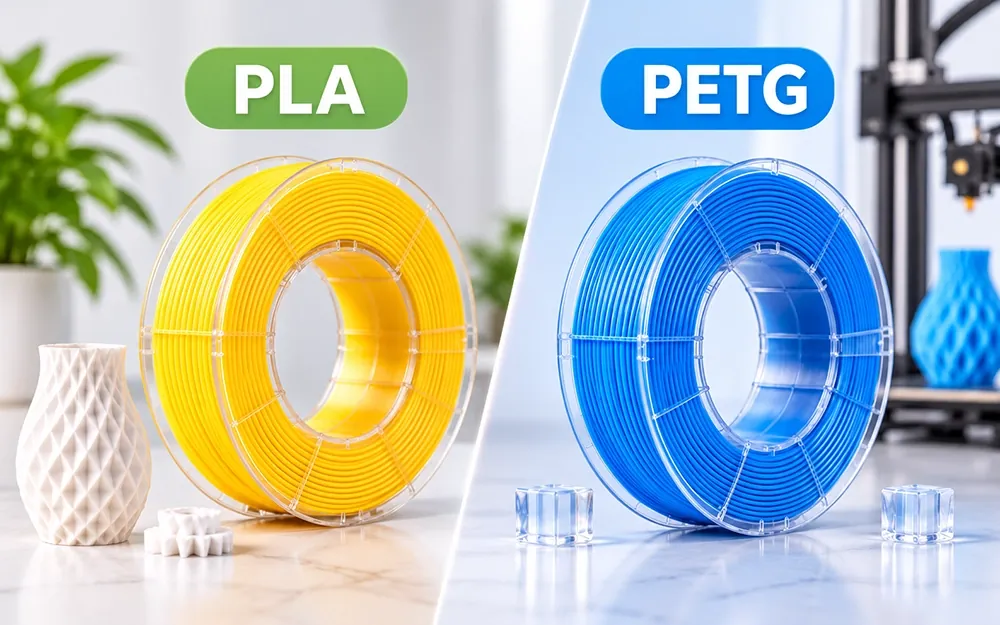
Use PLA for easy visual prints, models and most indoor prototypes. Use PETG when the part needs more toughness, moderate heat exposure, limited outdoor use or a clear finish. The difference is practical, not absolute. A poor print profile can ruin either material.
Material comparison data
| Material | Diameter | Density | Nozzle | Bed | Print speed | Key mechanical data |
|---|---|---|---|---|---|---|
| PLA | 1.75 mm | 1.25 ±0.05 g/cm³ | 195–230°C | 0–60°C | 40–60 mm/s | Tensile 60 MPa; Elongation 3.0%; Flexural 1,900 MPa |
| PETG | 1.75 ±0.02 mm | 1.27 g/cm³ | 220–250°C normal; 240–250°C high-speed | 60–80°C | 40–60 mm/s normal; 150–200 mm/s high-speed | Elongation 10%; Flexural 2,060–2,160 MPa |
Source: PIBUNO project material workbook and existing product templates. “Not supplied” means the project did not include a verified value; it is not an industry default.
PLA vs PETG at a glance
| Factor | PLA | PETG |
|---|---|---|
| Ease of printing | Usually easier | Needs more careful tuning |
| Detail and stiffness | Good detail and high stiffness | Good toughness, often less brittle |
| Heat resistance | Low to moderate | Moderate |
| Outdoor exposure | Limited | Better, but not a guarantee for long-term UV exposure |
| Transparency | Usually translucent or cloudy | Can produce clearer translucent parts |
| Stringing risk | Moderate | Often higher |
| Bed adhesion | Usually manageable | Can bond too strongly to some surfaces |
| Typical use | Models, signs, prototypes, decorative parts | Brackets, covers, functional parts, clear samples |
How each material prints
PLA usually starts around 190-220 C at the nozzle and 50-60 C on the bed. Most printers handle it with broad cooling. Fine points, text and sharp edges print cleanly.
PETG commonly starts around 230-250 C at the nozzle and 70-80 C on the bed. It often needs slower first-layer speed, more nozzle clearance and controlled cooling. If the nozzle presses too close, the part can stick aggressively or form a rough top surface.
PETG also tends to string more. Dry the spool before assuming the profile is wrong. Then test retraction distance, temperature and travel speed.
Use the recommendation on the exact spool first. Pibuno's PETG printing temperature guide explains the setup in more detail.
Strength means different things
PLA has high stiffness. A thin PLA model can feel rigid and hold its shape under light load. It is also more brittle in a sharp impact.
PETG bends before it breaks in many applications. That makes it useful for clips, brackets, guards and parts that see moderate impact. PETG is not automatically stronger in every direction, and a poorly bonded layer remains the weak point.
For structural work, geometry and print orientation can matter more than the material label. A long part printed with weak layer direction may fail even when the filament is sound.
Heat and weather
PLA softens at relatively low temperatures. A part left in a hot car or used near warm equipment may deform. PETG handles more heat, though conditions vary by grade and print profile.
PETG can tolerate some outdoor use, but UV exposure and sustained weather are different requirements. ASA is a more deliberate choice for long-term outdoor parts. The ASA vs ABS comparison explains the weather-resistance tradeoff.
Finish and transparency
PLA is often chosen for clean colors, silk effects and matte surfaces. Layer lines can be visible, but fine detail remains sharp.
PETG can create translucent parts, but FDM printing rarely makes glass-clear objects. Thin walls, solid infill, layer direction and surface finishing all affect light transmission. A glossy surface can look clear in a photograph and still show haze in person.
Cost and production behavior
Material price is only one part of the cost. Print speed, failure rate, support removal, spool changes and packaging all matter.
PLA often reduces initial tuning time. PETG may need more profile work but can replace a more expensive material for a tougher part.
For repeat orders, ask for diameter tolerance, net weight, color approval and batch records. Pibuno lists PLA materials and PETG materials by product family so buyers can compare the actual application before choosing a grade.
Dimensional stability and long-term load
A material can pass a short bend test and still change slowly under a sustained load. The surrounding temperature matters because many plastics creep more as they approach their heat limit.
A PLA shelf bracket may work in a cool room and gradually deform near a window or appliance. PETG has more heat tolerance, but it can also creep under a load at a temperature below its short-term failure point.
For a structural part, test the full assembly under the expected load for a realistic period. Measure the gap or deflection before and after. A five-minute hand test does not show long-term creep.
Print-direction effects
Both materials are weaker at the bond between layers than within a continuous strand. A part printed upright may fail along a horizontal plane, while the same shape printed on its side can carry more load.
The best material cannot fix an orientation that places the main load directly across weak layers. Review the load direction in the slicer before comparing material data.
For a PLA versus PETG decision, print the same geometry in both orientations. This shows whether the material difference is large enough to matter for the real part.
Profile differences that change the result
Do not compare fresh material using one generic PLA profile with PETG printed outside its recommended range. Each material should get a sensible test condition.
| Test item | PLA baseline | PETG baseline |
|---|---|---|
| Nozzle | Follow supplier range, often 190-220 C | Follow supplier range, often 230-250 C |
| Bed | Often 50-60 C | Often 70-80 C |
| Part cooling | Usually moderate to high | Usually lower and controlled |
| First layer | Moderate speed | Slower and less squashed |
| Moisture | Dry if brittle or popping | Dry before clear or critical parts |
| Bed release | Check sheet condition | Confirm the PETG-safe release method |
Keep the tested temperature and speed with the sample. A photo of a finished part does not preserve the conditions that produced it.
Surface and post-processing
PLA sands and bonds readily with common modeling methods. It can accept paint or filler, but the preparation still affects the final finish.
PETG is more resistant to some solvents, which can make bonding or smoothing more process-dependent. Test any adhesive or coating on scrap material before using it on a production part.
For clear or translucent PETG, polishing can improve the surface but adds labor. The transparent appearance is affected by layer boundaries and internal infill, not only surface gloss.
Moisture changes the comparison
A wet PETG spool can foam, string and produce inconsistent walls. If it is compared against dry PLA, the test may incorrectly suggest that PETG has poor print quality.
Dry both materials according to their specifications and print a small control sample. Keep the spools sealed while testing.
The drying guide explains how to separate moisture problems from temperature or nozzle problems.
Choose by failure mode
Use PLA when you want:
- A stiff display part
- Clean detail
- A broad color selection
- A forgiving setup on an open printer
Use PETG when you want:
- More impact toughness
- Moderate heat resistance
- A translucent part
- A material that can survive more handling than brittle PLA
For heat, weather and impact together, ask whether ASA or another engineering grade is a better fit. The filament types guide explains the alternatives.
A practical approval sequence
- Define the load, temperature and environment.
- Select a material family that can plausibly meet them.
- Obtain the exact grade and a physical sample.
- Print the production geometry in the intended orientation.
- Measure dimensions and test the expected failure mode.
- Repeat with a second spool or lot when repeatability matters.
This sequence keeps the material comparison tied to the finished part. That is more useful than choosing the stronger-sounding name.
When dimensional accuracy decides the choice
Both PLA and PETG can produce accurate parts when the printer and profile are controlled. Shrinkage, cooling and layer bonding can still change holes, shafts and mating surfaces.
Do not use the material's name as a dimensional tolerance. Print a coupon with the same wall thickness and hole sizes as the product, then measure the result after cooling.
PETG may require compensation for elephant-foot and hole shrinkage. PLA can also change around a warm insert or a tight press fit.
For assemblies, test the joined parts rather than separate coupons. A hole that measures correctly can still fail if the material creeps or the mating material behaves differently.
Sample acceptance checklist
Approve a production sample only after checking:
- Dimensions at the critical surfaces
- Layer direction and the expected failure plane
- Surface and color under final lighting
- Weight and material use
- Support removal
- Smell or process emissions in the actual workspace
- Behavior after the expected heat or load
Record the spool, profile and test date. If a later batch changes material flow or color, the approval may no longer apply.
A simple selection rule
Choose PLA when:
- The part is mainly for display or fit checking.
- Fine detail and color matter more than heat.
- The printer has no enclosure.
- Fast, predictable setup is important.
Choose PETG when:
- The part needs to flex or absorb light impact.
- A little more heat resistance is useful.
- The design benefits from translucency.
- You can test for stringing and excessive bed adhesion.
Test before a production order
Print the same small part in both materials. Record nozzle temperature, bed temperature, flow, cooling, speed and retraction. Drop the part, flex it, expose it to the real use temperature and check surface quality.
That test costs little. It can prevent a much larger batch decision based on color alone.
FAQ
Is PETG stronger than PLA?
PETG is generally tougher and less brittle, while PLA is stiffer. The better material depends on whether the part needs rigidity or impact resistance.
Is PLA easier to print?
Usually, yes. PLA has a wider practical process window on many open printers. PETG needs more attention to nozzle height, cooling and bed release.
Can PETG replace ABS?
Sometimes. PETG is easier to print than ABS in many setups, but it is not a universal replacement for heat resistance or established ABS production. Compare the actual service temperature and mechanical load.
Which is better for clear parts?
Transparent PETG is a better starting point than standard PLA, but print geometry and finishing still affect clarity. A clear spool does not guarantee a clear printed part.