

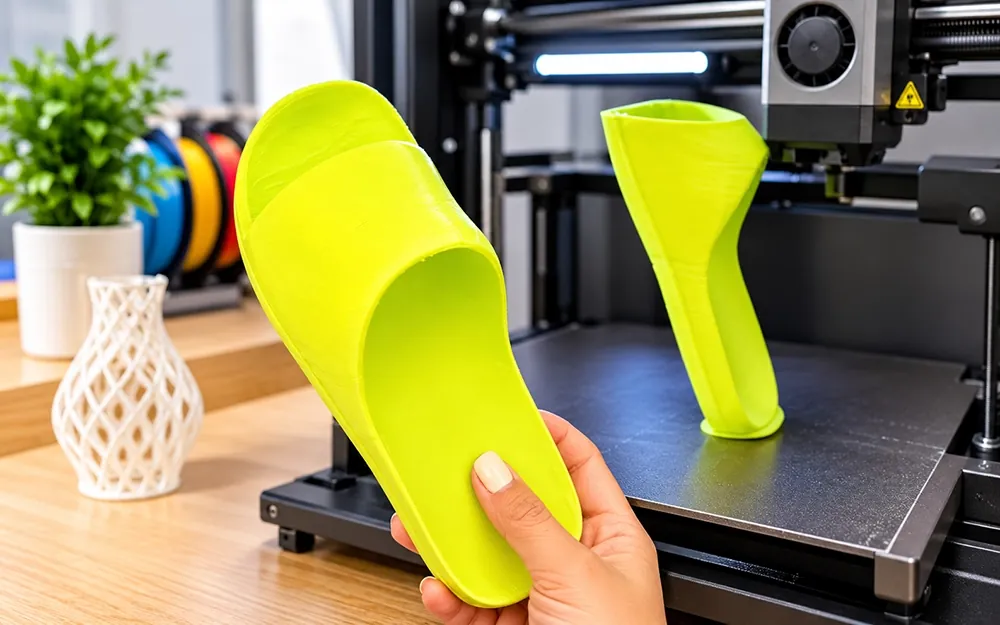
TPU is a flexible polyurethane filament used for parts that bend, compress, grip or absorb impact. Shore hardness, rebound, tear resistance and printer setup determine whether a particular TPU fits the job.
PIBUNO material data
| Parameter | PIBUNO supplied value |
|---|---|
| Material | TPU |
| Grade / effect | 95A flexible TPU |
| Diameter | 1.75 ±0.02 mm |
| Diameter tolerance | ±0.02 mm |
| Net weight | 200 g / 500 g / 1 kg |
| Shore hardness | 95A |
| Nozzle | 215–235°C |
| Bed | 0°C or 60–80°C |
| Print speed | 20–40 mm/s |
| Data status | Partial |
| Source note | Flexible feed path and low speed are required. |
Source: PIBUNO project material workbook and existing product templates. “Not supplied” means the project did not include a verified value; it is not an industry default.
What TPU filament is
TPU stands for thermoplastic polyurethane. It can be melted and extruded like other FDM filament, then cools into a flexible part.
Unlike a rigid plastic, TPU can stretch and recover. That makes it useful for straps, protective corners, seals, grips, phone holders and soft-touch parts.
TPU is not one material formulation. Two 95A products can differ in stiffness, rebound, surface finish and print speed because the polymer and additives are different.
What Shore hardness means
Shore A is the common hardness scale for flexible filament. A lower number is softer. A higher number is firmer.
| Typical range | Feel | Common use |
|---|---|---|
| 85A or softer | Very flexible | Soft grips, elastic parts |
| 90A-95A | Firm flexible | Wearables, bumpers, protective parts |
| 98A or harder | Semi-flexible | Supports and durable flexible components |
Hardness is a starting point, not the whole specification. Ask about rebound, tear strength and recommended print speed.
The printer setup matters
A direct-drive extruder with a short filament path usually handles TPU more reliably. Long Bowden tubes make it easier for soft filament to buckle or stretch.
Start with:
- Low print speed
- Low or disabled retraction
- Moderate extruder tension
- A clean, short filament path
- Spool support that turns freely
High speed creates pressure in the melt zone and can cause under-extrusion. High retraction can pull the soft strand away from the nozzle and create gaps.
Design for flexible parts
Think about how the part will bend. A large solid block behaves differently from a thin ribbed shape. Thin sections can stretch more, while thick sections may feel much firmer.
Use generous radii and avoid sharp internal corners where stress can collect. If the part needs both flexible and rigid areas, consider a multi-material design or two separate parts.
TPU versus other flexible materials
TPU is generally tough and abrasion-resistant. TPE and other flexible compounds may have a different feel or processing window. Ask for the exact material data instead of assuming all “flexible filament” behaves the same.
The Pibuno TPU category and product catalog provide product starting points.
The filament types guide explains how TPU fits alongside rigid materials.
Printing and moisture
TPU can absorb moisture. Dry the spool and store it in a sealed container when print quality becomes inconsistent.
Signs of moisture include popping, rough surfaces and unstable extrusion. Fix those before changing the temperature or retraction repeatedly.
A practical test
Print a short flexible strip with a bending loop and two flat grip sections. Check whether the material feeds smoothly and whether the part returns to shape.
Record the speed, temperature and retraction settings. The same spool may need different settings on a direct-drive printer, a Bowden system or a high-flow tool head.
Common mistakes
Do not use high retraction by default. Do not run a flexible spool through a path with sharp bends. Do not assume a lower Shore hardness is better. A 95A grade may be a better fit for a durable grip than a very soft material that tears.
Translate Shore hardness into product feel
Shore hardness describes indentation resistance under a specified test. It does not tell the full story of a grip, seal or bumper.
Two materials with the same Shore A number may feel different because one springs back quickly and another stays compressed. Tear resistance also changes how a thin section survives repeated use.
Print the actual geometry at the planned wall thickness. A thick block may feel firm even when the material is flexible, while a thin rib can stretch much more.
Choose TPU by application
| Application | Main requirement |
|---|---|
| Phone grip or handle | Surface friction and rebound |
| Protective corner | Impact absorption and tear resistance |
| Flexible strap | Stretch, recovery and fatigue |
| Gasket | Compression and surface contact |
| Soft-touch housing | Flexibility with enough shape support |
For a part that combines flexible and rigid functions, consider separate components. Printing one material into a role it cannot perform usually creates a heavier design rather than a better one.
Design the feed path
A flexible strand can stretch or buckle if the path creates too much friction. A short, supported path from spool to extruder reduces that risk.
Check the spool tension. A heavy reel that turns poorly can pull the filament into the extruder at an uneven rate. A tangled spool can create a sudden load that is hard to diagnose from the slicer.
Use a broad guide where possible. Avoid a sharp bend immediately before the drive gears.
Start with a slow profile
A conservative TPU profile uses low speed and limited retraction. Begin with the material recommendation and print a small flexible strip.
Watch the motor and filament path. Clicks, shavings or a visible pulse in the extrusion indicate that the system is losing grip.
Increase speed only after the feed is stable. A direct-drive printer may handle more speed than a long Bowden path, but the hot end and part geometry still matter.
Drying and storage
TPU can absorb moisture. If the extrusion becomes foamy or the surface turns rough, dry the spool and store it with desiccant.
Do not expose the entire spool to high heat. Follow the supplier's range and keep the spool out of contact with a hot surface.
A useful acceptance test
Print a strip with a bend, a hole and a grip section. Flex it repeatedly and check:
- Delamination
- Tearing at the hole
- Permanent deformation
- Surface damage
- Layer bonding
The material and geometry should be tested together. A flexible filament that passes a bend test can still fail at a thin mounting tab.
Procurement details
Ask for the grade, Shore hardness, color, diameter, net weight, spool format and recommended drying conditions. Keep a retained sample for repeat orders.
TPU troubleshooting table
| Result | Likely check |
|---|---|
| Extruder clicks | Speed, tension, hot-end pressure and feed restriction |
| Gaps after retraction | Reduce retraction and test travel |
| Rough surface | Dry the spool and verify the temperature |
| Tangled or stretched feed | Spool drag, guide friction and filament path |
| Weak layer bond | Temperature, speed, cooling and moisture |
| Tearing at a hole | Geometry, wall thickness and material hardness |
Change one factor per test. Flexible filament can hide the difference between a feed problem and a profile problem.
Compare flexible materials carefully
TPU is not the same as every soft filament. TPE and other compounds can have different rebound, surface feel and processing requirements.
Ask for the material family and the mechanical data that matters to the part. A product label that only says “flexible” is too broad for a structural or sealing decision.
Packaging and repeat orders
Flexible material can be more sensitive to spool winding and path friction. Check that the new spool feeds at the same angle as the approved sample.
Keep the material, hardness, color and product profile together. If a customer asks for the same grip in a future order, the previous sample is more useful than a name alone.
Test recovery, not only stretch
Pull the test strip to a defined extension, release it and measure whether it returns to the original length. Repeat the cycle.
Permanent deformation, whitening or a tear at the mounting hole can matter more than the initial feel. Test the part after the expected number of uses rather than once.
For a sealing part, compression set can also matter. A material that feels appropriately soft may not recover enough for a reusable seal.
Control the first 20 layers
Flexible filament is often least stable as the nozzle pressure builds. Watch the first few layers for gaps, shaving or a strand that buckles in the feed path.
If the first layer is inconsistent, reduce speed and check nozzle height. A high first layer may require more flow than the extruder can push without slipping.
Maintain the machine
Clean the extruder gears and remove dust from the filament path. Check that the tube or guide is not worn into a sharp edge.
For production, keep a rejected test strip from the approved profile. Compare new operators and new spools against that physical reference.
Use the right cooling
Excessive cooling can reduce layer bonding in flexible parts. Test the minimum cooling that keeps overhangs stable. On tall thin parts, observe whether the material begins to curl or the extrusion becomes unstable.
FAQ
Is TPU flexible?
Yes. TPU is selected for parts that need to bend, compress or absorb impact. Hardness and formulation change how it feels.
Can a standard printer print TPU?
Many printers can, especially with a direct-drive extruder and slow settings. Check the manufacturer's supported materials and test with a small part.
Is TPU toxic?
Do not treat a material label as a safety claim. The formula, printing conditions and intended use matter. Follow the maker's instructions and use appropriate ventilation.
How should TPU be stored?
Keep it sealed with desiccant and dry it if print quality indicates moisture. Flexible filament can print poorly when it absorbs water.