

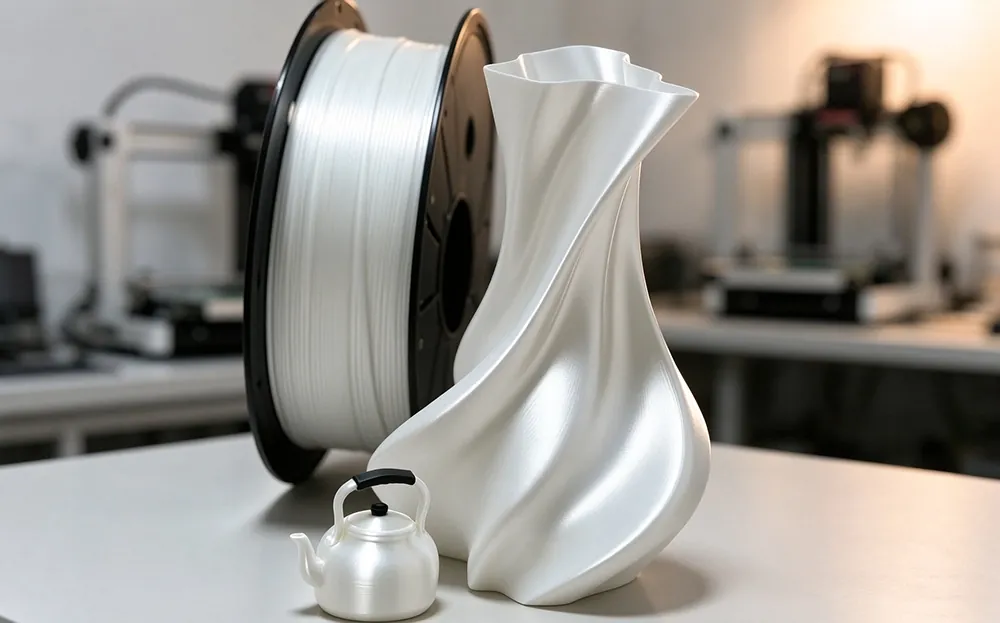
Silk PLA is a PLA-based filament formulated to produce a glossy, reflective surface. It is mainly used for decorative models, gifts, cosplay pieces and retail displays. Its appearance changes with print temperature, speed and geometry.
Material comparison data
| Material | Diameter | Density | Nozzle | Bed | Print speed | Key mechanical data |
|---|---|---|---|---|---|---|
| Silk PLA | 1.75 mm | 1.25 g/cm³ | 220–230°C | 40–60°C | 50–60 mm/s | Flexural 2,060–2,160 MPa |
| Rainbow Silk PLA | 1.75 mm | 1.25 g/cm³ | 220–230°C | 40–60°C | 50–60 mm/s | Flexural 2,060–2,160 MPa |
Source: PIBUNO project material workbook and existing product templates. “Not supplied” means the project did not include a verified value; it is not an industry default.
What makes it look silky
The finish comes from the polymer formulation and how the printed surface reflects light. Layer direction and lighting strongly affect the result.
The material is still PLA at its base, so its heat and impact limitations remain.
Where silk PLA works
Silk PLA suits:
- Display models
- Decorative objects
- Cosplay accessories
- Gift and souvenir products
- Architectural or product concepts
It is less suitable for parts that will get hot, carry high loads or remain outdoors.
Print settings
Print temperature affects gloss, flow and detail. A cooler surface can look more matte; too much heat can increase stringing and soften fine features.
Print a small test at several temperatures and speeds. Keep the setting that gives a clean surface without sacrificing layer bonding.
The PLA temperature guide provides a starting point.
Color and lighting
The same silk spool may look gold in warm light and more bronze in cool light. Approve the physical sample under the customer's lighting.
For a product line, keep a reference print and a color standard.
Product links
Pibuno's PLA category and effect material range show visual-effect product directions.
The filament types guide explains how silk, matte and rainbow finishes differ.
Match the finish to the model
Silk highlights broad curved surfaces. Very busy geometry can make reflections fragmented, while a smooth shell may reveal small blemishes.
Simple shapes with large radii often show the finish best. A model with thin spikes or hidden internal surfaces may not benefit from the extra material cost.
Design and post-processing
Keep the visible surface away from supports. A support scar on a reflective shell is more obvious than on a matte finish.
Light sanding can remove small defects, but it may change the gloss. Test any polishing or coating on a scrap print before touching a display model.
Production planning
For a repeated product, approve a finished sample rather than only a color chip. Record the spool batch, profile and appearance standard.
Inspect parts under the light used by the customer. A retail display, a photograph and a home shelf can make the same finish look different.
What silk changes in printing
The reflective surface can expose flow changes and layer boundaries. A dirty nozzle or inconsistent diameter may be more visible than on a matte material.
Start with a clean nozzle and the supplier's temperature range. Print a small curved surface, because a flat coupon does not show the same highlight.
Use it for visual products
Silk PLA can suit decorative objects, gifts, display models and branded samples. It is less suitable for hot or load-bearing parts.
Keep the geometry simple where possible. Large smooth curves often show the finish more clearly than dense detail.
Handle and finish
Avoid rough support removal on the visible surface. Test any polishing or coating on scrap because it can change the gloss.
For a repeat product, approve a physical sample and keep the material, color and orientation with it.
Store and inspect
Keep the spool dry and away from heat. Inspect new lots for color and surface before production.
The PLA category and effect material range provide comparison points.
Compare the finish to the product
Silk PLA can create a premium appearance on a smooth shell. It may not suit a part with dense texture or hidden surfaces.
Matte PLA can be better when glare or layer reflections are unwanted. Standard PLA may offer a wider working range for functional prototypes.
Approve the finish on the final geometry, not a flat swatch.
Control the visible surface
Keep support away from the display side and orient the part so highlights follow the intended shape.
Check the first layer and seam placement. A visible seam can interrupt the reflective appearance.
Troubleshoot the finish
Patchy gloss can come from inconsistent flow, temperature or cooling. A rough surface may point to moisture.
Print a small curved sample after each change. Keep the result with the spool and profile.
Decide whether the effect is worth it
Silk PLA can justify itself for gifts, display models and branded samples. It is less useful for hidden structural parts where appearance adds no value.
Compare silk with matte and standard PLA
Silk emphasizes gloss and reflection. Matte reduces glare and can hide layer transitions. Standard PLA is often the simplest choice when appearance is secondary.
The difference is visual, but the print profile can also differ. Test each finish before assuming a color swap is the only change.
Check spool consistency
Inspect the first and last sections of a production spool for color and diameter. A strong visual finish is not useful if the next section changes.
Keep the approved spool label and printed reference.
Decide when to reject
Reject a sample with patchy gloss, visible flow bands, support scars or a color difference under the approved light.
Record the defect and the sample so the next lot has a comparison.
Set the display standard
Define the viewing angle, light and acceptable surface defects for the product.
Silk reflections can reveal small flow changes that do not matter on a matte surface. A physical approval sample is the clearest reference.
Choose the right model
Smooth shells and large curves show the finish. Very fine detail may need a different PLA type.
Test support placement because a scar can be more visible on a reflective surface.
Set an appearance limit
Define acceptable variation in color, gloss and seam position. A material sample without an appearance standard is difficult to repeat.
Keep the reference under controlled light and compare new lots before shipping.
Consider handling
Silk surfaces can show fingerprints and scratches. Protect finished parts during assembly and packing.
Test any protective film or coating before a customer order.
Compare silk with standard and matte
The three finishes are visual choices first. Silk emphasizes highlights, matte reduces glare and standard PLA offers a broad everyday baseline.
Print the same small model in each finish when the buyer is deciding from appearance. Keep lighting and orientation consistent.
Plan the visible surfaces
Place seams and supports where they will be less visible. Handle finished parts with clean gloves when fingerprints would affect presentation.
Check the final color and gloss
Place the approved sample beside the new part under the same light. Look for a directional change in gloss, not only a color difference.
Inspect several surfaces of the same model. A curved shell can reflect light differently from a flat wall.
Record the printer and profile with the reference. A new nozzle or flow setting can change the look even with the same spool.
Protect the surface
Store finished parts so they do not rub together. Test protective bags or coatings before a retail order.
Define the visual acceptance
Approve color, gloss and seam visibility under the final light. Keep the physical sample with the material and print profile.
If a later spool looks different, print the same model before using it in a retail order.
Confirm the finish after assembly
A silk part can look different after handling or assembly. Inspect the finished product, not only the freshly printed shell.
If a coating or protective film is added, test whether it changes the gloss.
Compare the final parts
Inspect the approved sample and the new part under the same lighting. Check color, gloss and visible seams.
If the difference affects the product, print another sample before the order continues.
Keep the approved sample in a protective sleeve and record the print orientation. The same material can look different when the visible surface is printed at another angle.
Compare the whole product
Check the finish after assembly because fasteners, seams and handling can change the presentation.
Review the finished batch
Inspect the color and gloss across several parts. A difference at one end of the spool should be identified before packing.
Record the approved sample and material lot.
Approve the visible part
Inspect color, gloss and seam position on the assembled product. A test swatch does not show how the final light will reflect from the shape.
Keep a protected reference and the matching spool label.
Check the next batch under the same light before production.
If the finish changes across the spool, separate the affected material before packing the customer order.
FAQ
Is silk PLA stronger than regular PLA?
Silk formulations vary. Treat the finish as an appearance feature and test strength if the part carries a load.
Does silk PLA need special settings?
It often benefits from a temperature and speed test. Start with the spool recommendation.
Can silk PLA be used outdoors?
It is still PLA-based and generally not a first choice for heat or long outdoor exposure.
Why does silk PLA show layer lines?
Its reflective surface can make layer direction more visible. Geometry, lighting and settings all affect the result.