

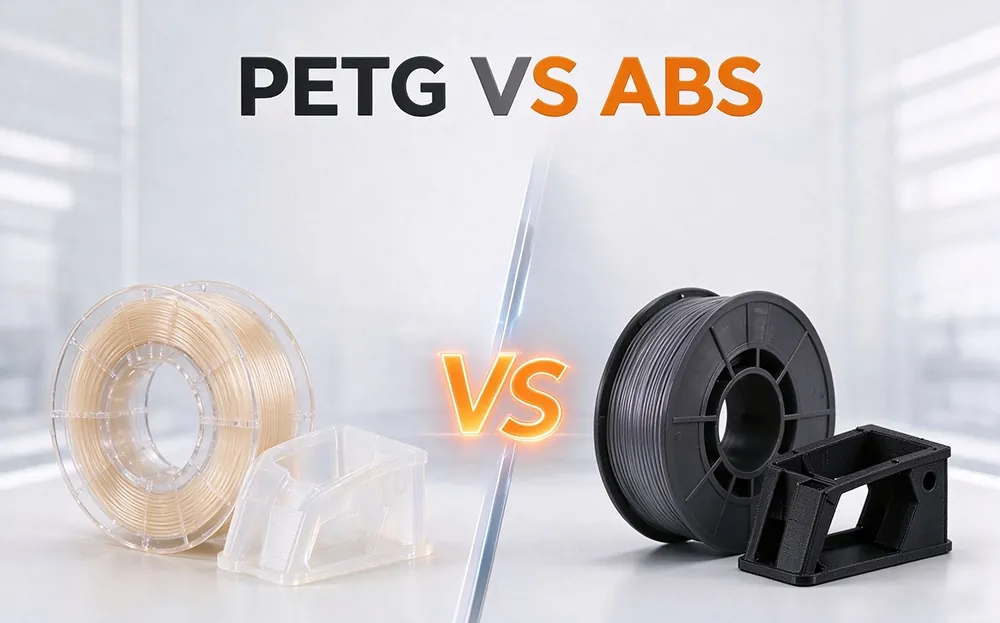
Choose PETG when easier printing and moderate toughness are more important than high heat. Choose ABS when the application benefits from its heat and impact behavior and the printer has the right enclosure and process control.
Material comparison data
| Material | Diameter | Density | Nozzle | Bed | Print speed | Key mechanical data |
|---|---|---|---|---|---|---|
| PETG | 1.75 ±0.02 mm | 1.27 g/cm³ | 220–250°C normal; 240–250°C high-speed | 60–80°C | 40–60 mm/s normal; 150–200 mm/s high-speed | Elongation 10%; Flexural 2,060–2,160 MPa |
| ABS | 1.75 mm or 3.0 mm | 1.04 ±0.5 g/cm³ as supplied | 230–250°C | 70–90°C | 30–50 mm/s | Tensile ≥43 MPa; Elongation ≥10.0%; Flexural ≥60 MPa |
Source: PIBUNO project material workbook and existing product templates. “Not supplied” means the project did not include a verified value; it is not an industry default.
PETG vs ABS at a glance
| Factor | PETG | ABS |
|---|---|---|
| Printing difficulty | Moderate | Higher |
| Heat resistance | Moderate | Higher |
| Impact behavior | Tough | Tough |
| Transparency | Translucent options | Opaque |
| Fumes and odor | Less pronounced than ABS | Ventilation important |
| Warping risk | Lower | Higher on large parts |
Printability
PETG can stick too strongly to a bed and form strings. ABS can warp and needs a controlled chamber and temperature.
Neither is as forgiving as standard PLA. Test each material on the actual printer geometry.
Heat and impact
ABS generally handles more heat than PETG. It can also suit parts that need durable impact behavior.
PETG may be adequate for an indoor bracket or cover that sees moderate handling. Do not use a material comparison as a substitute for an application test.
Surface and transparency
PETG can produce translucent parts. ABS is typically opaque. If appearance matters, approve a physical printed sample.
Fumes and workspace
ABS printing can produce odors and emissions. Use appropriate ventilation. PETG still requires good workshop practice and material controls.
Product links
See the Pibuno PETG category, ABS category and engineering filament category.
For outdoor exposure, the ASA vs ABS guide is a better next step.
Match the surface to the product
PETG can make a cover or window look lighter and more translucent. ABS provides an opaque industrial surface and can be sanded or finished in ways that suit enclosure work.
The best surface is not necessarily the shiniest one. Consider how the part will be cleaned, handled and viewed.
Plan the first production test
Print the same bracket in both materials with their approved profiles. Load it the way the customer will use it. Check deformation, screw holes and layer separation.
Keep the test profile with the result. A material difference is meaningful only when both samples are produced under reasonable conditions.
PETG vs ABS table
| Property | PETG | ABS |
|---|---|---|
| Ease of printing | More practical on open printers | Requires more control |
| Heat | Moderate | Higher |
| Impact | Tough | Tough |
| Transparency | Translucent options | Opaque |
| Warping | Lower | Higher |
| Fumes | Lower odor in many cases | Ventilation important |
Design differences
PETG can be useful for covers and guards that need a little flex. ABS can be useful for durable indoor housings.
For outdoor UV and weather, compare ASA rather than choosing between PETG and ABS alone.
Test both materials
Print the real geometry in both materials with appropriate profiles. Apply the intended load and temperature.
Check fastener behavior, holes and layer direction. A material result from a solid cube may not transfer to a thin housing.
When to ask for another material
If the part needs high impact and high heat, PC or another engineering grade may be a better fit. If it needs flexibility, TPU is the starting point.
Surface and appearance
PETG can produce a smoother or glossier surface depending on profile. ABS can be sanded and finished for an industrial housing.
Neither material produces a glass-clear FDM part. For a transparent window, compare the actual samples.
Moisture and drying
Both materials can absorb moisture, but the practical sensitivity differs by grade and environment.
Dry the material before a critical test. A wet spool can mislead the comparison and create surface defects.
Production handoff
Record the material, printer, temperature, speed and test result for each sample. Keep the failed part when the failure explains the decision.
Final selection
Choose PETG for easier processing and moderate toughness. Choose ABS for higher heat and an established indoor engineering workflow.
Choose ASA when outdoor UV exposure matters. The ASA vs ABS guide covers that decision.
Prepare the machine
PETG usually benefits from slower first layers and controlled cooling. ABS needs stable chamber conditions and attention to drafts.
Use the profile for the actual printer and material. A generic setting copied from another machine can make either material look unsuitable.
Check long-term fit
Apply the expected load and heat to the assembly. Check screw holes, snap fits and flatness after cooling.
The PETG temperature guide and ABS temperature guide provide setup starting points.
Plan the sample set
Print the same geometry with both materials and keep the intended infill and wall count.
Use a material-specific profile rather than one shared profile.
Evaluate the result
Check fit, surface, impact and heat behavior. Keep the failed sample if the failure explains the choice.
Record the material lot and profile.
Check the printer after the test
Inspect the nozzle and bed after PETG and ABS runs. Residue or damage can affect the next material.
Use a clean surface and a known profile before the production part.
Document the chosen result
Keep the test part, material label and reason for selection. The record should explain why the chosen material fits the application.
Choose by the production constraint
If the printer is open and the part needs moderate toughness, PETG is often easier to start with.
If the part needs higher heat and the printer has an enclosure and ventilation, ABS may be the better engineering fit.
For weather exposure, use ASA. For flexible behavior, use TPU.
Keep the sample set
Retain one PETG and one ABS part produced with their approved profiles. Use them for future comparisons instead of relying on the two material names alone.
Plan the first article
Use the product geometry and both intended materials. Print them with their own profiles and keep the material lot.
Check corners, holes, layer direction and surface. Apply the expected temperature and load after cooling.
The result should identify which material passes the requirement, not only which sample looks nicer.
Compare service conditions
PETG is often suitable for moderate indoor toughness. ABS can support higher heat with an enclosure and ventilation.
For outdoor UV, compare ASA. For flexible parts, compare TPU. The filament types guide gives the wider decision path.
Use the part test to decide
Print both candidates in the production geometry and orientation. Record dimensions, warping, impact and heat result.
Keep the approved material, profile and physical sample together.
The best filament guide explains how to extend the choice to other material families.
Check the material after printing
Inspect the production geometry for warping, surface and joint fit. The test should use the expected fastener and load.
Keep the result with the material lot and profile.
Review the production result
Print the same part with each material and appropriate process. Check warping, surface and the planned joint.
The result should include the material and printer used.
Compare the failure or deformation with the intended use. A PETG sample may look better while ABS better meets a heat requirement.
Keep the material-specific profile
Do not use the PETG profile for ABS or the reverse. Bed adhesion, cooling and chamber behavior differ enough to change the result.
Record the settings with each sample so the comparison is repeatable.
Record the production decision
Store the tested geometry, material lot and profile. A future change in printer or room conditions can change the result.
Use the selected sample to explain why the material fits the application.
Compare the service condition
PETG suits easier printing and moderate toughness. ABS can provide more heat resistance when the printer and workspace are prepared.
Test the real part at the intended temperature and load. Keep the material lots and profiles with the results.
The Pibuno product catalog lists the material families, but the printed test is the final decision.
Keep the results with the exact material lot and printer profile so the choice can be repeated.
A repeat order should be compared with the approved geometry before production.
Check the production result
Print the real geometry in each material with the appropriate profile. Measure warping, fit and heat response after cooling.
Keep the selected sample with the material label and printer settings.
Keep the selected material traceable
Record the material lot, color and printer profile with the approved part. A future batch should be compared with those inputs.
The comparison should also state why the rejected material was unsuitable for the product, not just why the selected material printed well.
Compare the finished assembly
Print the intended part and test the actual fastener or mating component. The selected material must work in the assembly, not only as a standalone coupon.
The final choice should be recorded with the tested geometry and material lot.
FAQ
Is PETG stronger than ABS?
The answer depends on the load. PETG is generally tougher than PLA and easier to print than ABS. ABS can provide more heat tolerance and different impact behavior.
Which material is easier to print?
PETG is usually easier than ABS on an open printer, but bed adhesion and stringing need attention.
Does ABS need ventilation?
Use appropriate ventilation and follow the material and equipment instructions.
Can PETG replace ABS?
It can for some moderate applications, but not where ABS heat performance or an established engineering specification is required.