

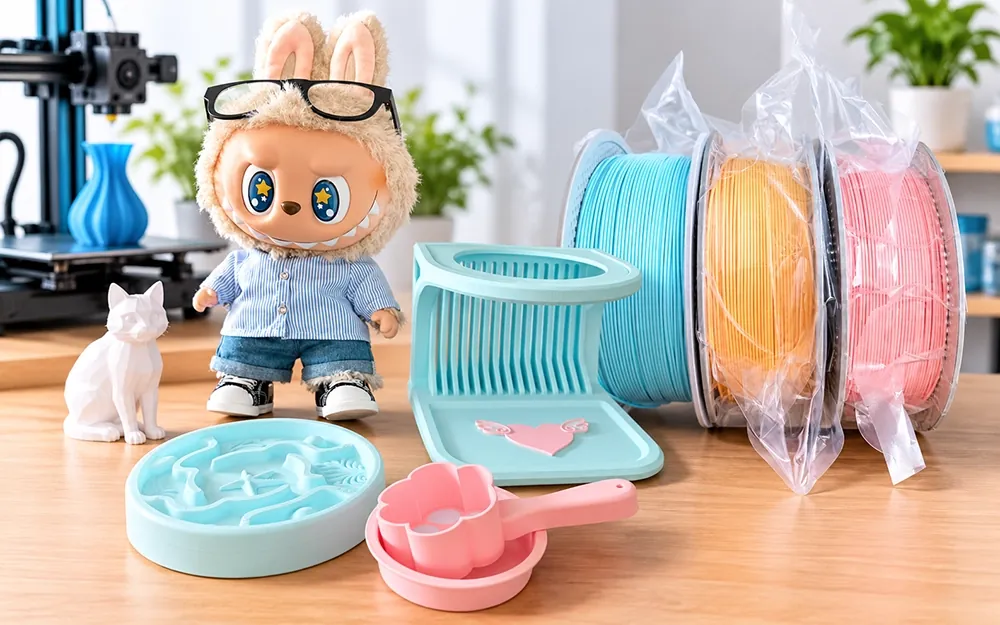
A food-safe filament does not automatically make a printed part safe for food contact. The material, print process, surface condition, cleaning method, intended use and supporting documentation all need review. A supplier should make it clear what was tested and what the claim covers.
Material comparison data
| Material | Density | Nozzle | Bed | Print speed | Key mechanical data | Data status |
|---|---|---|---|---|---|---|
| PLA | 1.25 ±0.05 g/cm³ | 195–230°C | 0–60°C | 40–60 mm/s | Tensile 60 MPa; Elongation 3.0%; Flexural 1,900 MPa | Complete |
| PETG | 1.27 g/cm³ | 220–250°C normal; 240–250°C high-speed | 60–80°C | 40–60 mm/s normal; 150–200 mm/s high-speed | Elongation 10%; Flexural 2,060–2,160 MPa | Partial |
| ABS | 1.04 ±0.5 g/cm³ as supplied | 230–250°C | 70–90°C | 30–50 mm/s | Tensile ≥43 MPa; Elongation ≥10.0%; Flexural ≥60 MPa | Partial / verify |
Source: PIBUNO project material workbook and existing product templates. “Not supplied” means the project did not include a verified value; it is not an industry default.
Filament safety and finished-part safety are different
Filament is an input material. The final product also includes the printed shape, layer lines, support marks, inserts, coatings, cleaning routine and time in contact with food.
FDM parts have small gaps between layers. A smooth-looking surface can still hold residue or moisture. A material that is suitable in one form may not perform the same way after printing.
That is why a spool label alone is not enough for a food-contact decision.
What to ask about the material
Request documentation for the exact grade and color, not a generic family description. Useful questions include:
- What polymer and additives are used?
- What colorants are present?
- What country and facility make the material?
- What regulatory or migration testing applies?
- Does the documentation match the current formulation?
- Are there processing limits that affect the finished part?
If the answer changes when the color changes, the approval may not cover the product you plan to use.
What to ask about the printed part
The finished part needs its own review because geometry and processing affect the result. Ask:
- Will the part contact food directly or only packaging?
- Is contact dry, moist, acidic, fatty or repeated?
- What temperature will the food and part reach?
- How will the part be cleaned?
- Can brushes, cloths or cleaning agents damage the surface?
- Are there inserts, adhesives or coatings?
For commercial products, involve a qualified food-safety or regulatory reviewer. They should evaluate the full application rather than a filament sample on its own.
PLA and PETG do not settle the question
PLA and PETG are common FDM materials, but “PLA” or “PETG” does not prove food-contact suitability. Additives, pigments, processing aids and color can change the material. The shape and cleaning requirements still matter.
Some products are marketed as food-safe. Read the scope of that claim. It may apply to raw material, a finished article, a specific test condition or one market—not every use.
The U.S. Food and Drug Administration publishes information on food contact substances. Use official guidance as one input, then confirm the exact product and intended use.
Layer lines and cleaning
Food residue can collect in layer grooves, textured surfaces and small recesses. A design with wide radii and an open shape is easier to clean than a narrow channel with internal corners.
If the design needs a sealed surface, a coating or post-process may be proposed. That step introduces another material and another approval requirement. Do not assume a coating solves the problem until its use conditions and compatibility are documented.
Color and batch control
Food-contact projects often need more traceability than display products. A color approval should identify the physical reference, lighting conditions and acceptable tolerance. A production batch should be tied to the approved material and documentation.
For repeat orders, confirm that the supplier will notify the buyer if the formulation, colorant or production source changes.
Product planning in practice
Start with the intended use, not the spool label. Separate direct food contact from handling, packaging and display. Write down the contact time, cleaning routine and maximum temperature.
Then request samples and documentation for the exact grade. Print a representative part from the intended material and profile. Review the surface and cleaning behavior before a larger order.
Pibuno's PLA category and PETG category help buyers compare material families. The quality review page explains the information and approval points used for an order.
Material comparison without false assurance
PLA and PETG are common because they are easier to print than many engineering polymers. That does not establish food-contact suitability.
| Material | Common role | Food-contact question |
|---|---|---|
| PLA | Display, prototype, low-heat parts | Exact grade, colorants, printed surface and use condition |
| PETG | Tougher covers, translucent parts | Exact formulation, cleaning and finished-part application |
| ABS and ASA | Durable engineering parts | Material documentation and process emissions |
| TPU | Flexible parts | Additives, surface texture and cleaning difficulty |
| PC, PA, PEEK | Engineering applications | Grade-specific documentation and process conditions |
The material family can guide a sample request. It cannot replace the review of the finished article.
Design for cleanability
A food-contact design should be easy to inspect and clean. FDM layer texture can create pockets that are difficult to reach.
Prefer open geometry, generous radii and smooth transitions. Avoid narrow slots, blind holes and deep textures where residue can collect.
If the part needs a mating surface, consider how the joint will be cleaned. A gap that holds moisture or food is a design problem even when the filament has suitable documentation.
The print orientation matters too. A surface that touches food should not collect support marks or stringing.
Print process controls
The printer should be clean and reserved appropriately for the product. A nozzle that has run unknown materials may contaminate the surface. Dust, oil and loose debris should be controlled.
A small pilot part should use the same:
- Printer
- Nozzle and bed material
- Material grade and color
- Layer height
- Flow and temperature
- Cleaning routine
Do not evaluate a polished laboratory sample if the production part will be printed with a different machine and profile.
What documentation may include
Depending on the intended market and application, the supplier or reviewer may request:
- Material safety data sheet
- Food-contact or migration test report
- Declaration of compliance
- Colorant information
- Manufacturing location
- Shelf life and storage conditions
- Batch traceability
- Cleaning validation
These documents do not substitute for each other. A safety data sheet describes handling hazards; it does not automatically establish food-contact suitability. A raw-material declaration may not cover a finished printed part.
Cleaning questions
A cleaning process needs to be compatible with the plastic and with the product geometry. High heat, harsh chemicals or abrasive cleaning can damage a surface that starts out acceptable.
Ask:
- Is hand washing or machine washing required?
- What cleaning agent and temperature are allowed?
- Can the part be fully drained and dried?
- Will repeated cleaning change the surface?
- Can the user see and reach all contact surfaces?
The answer should be tested on the actual part. A generic “wash with soap and water” instruction may not be enough for a commercial product.
Sample approval
For an important project, compare at least:
- The approved color sample
- A printed sample from the intended material
- A sample after the planned cleaning cycle
- A retained reference kept in controlled storage
Take photographs under consistent light and record dimensions. This helps the buyer understand the physical standard without relying on a screen.
Claim discipline
Use limited language:
- “Material documentation is available for the exact grade.”
- “The application requires review by a qualified food-safety professional.”
- “The printed part was evaluated under the stated cleaning and contact conditions.”
Avoid broad claims such as “microwave safe,” “dishwasher safe,” “non-toxic for all food” or “FDA approved” unless the exact product and scope support the statement.
The strongest article does not make the decision sound easier than it is. It helps the reader identify the evidence and conditions the decision needs.
A final publication checklist
Before approving a food-contact claim, confirm that the evidence package answers all of these:
- What exact material and color were evaluated?
- What part geometry and print process were used?
- Which surface will contact food?
- What food type, temperature and contact time apply?
- What cleaning method was validated?
- Which document covers the finished application rather than only the raw filament?
- Who reviewed the claim and what limitations remain?
If any answer is missing, the claim should stay open. The article can still explain how to collect the evidence, but it should not tell the reader that an unverified product is safe.
Who owns the decision
The filament supplier can provide material information. The printer or product manufacturer can control the production process. The buyer or brand owner defines the intended use and retains responsibility for the final claim.
For a regulated product, a qualified food-safety or regulatory reviewer should connect those pieces. One supplier document does not transfer responsibility for the finished article.
Keep decisions and revisions in writing. If the material color, cleaning method, printer or part geometry changes, the reviewer should know which prior conclusion remains valid.
Common claim mistakes
Avoid saying “food safe” on a finished product just because the raw filament was described that way. Avoid treating a generic test report as approval for every color and design. Avoid claiming dishwasher-safe or reusable performance without testing the actual part.
The safer approach is specific language: identify the material grade, intended contact condition, cleaning method and documentation available.
FAQ
Is PLA food safe?
PLA is not universally food safe. The exact formulation, colorants, printed surface and intended use matter, and commercial applications should be reviewed by a qualified professional.
Is PETG better than PLA for food contact?
Neither material wins by name alone. Compare the exact grades, documentation and finished-part conditions.
Does a food-grade filament make the print safe?
No. The printed part also needs a suitable design, controlled process, clean surface and appropriate cleaning routine.
Can I sanitize a 3D printed part?
The method depends on the material, part geometry and intended use. Verify compatibility and cleaning performance with the actual product rather than assuming a standard washing method is safe.