

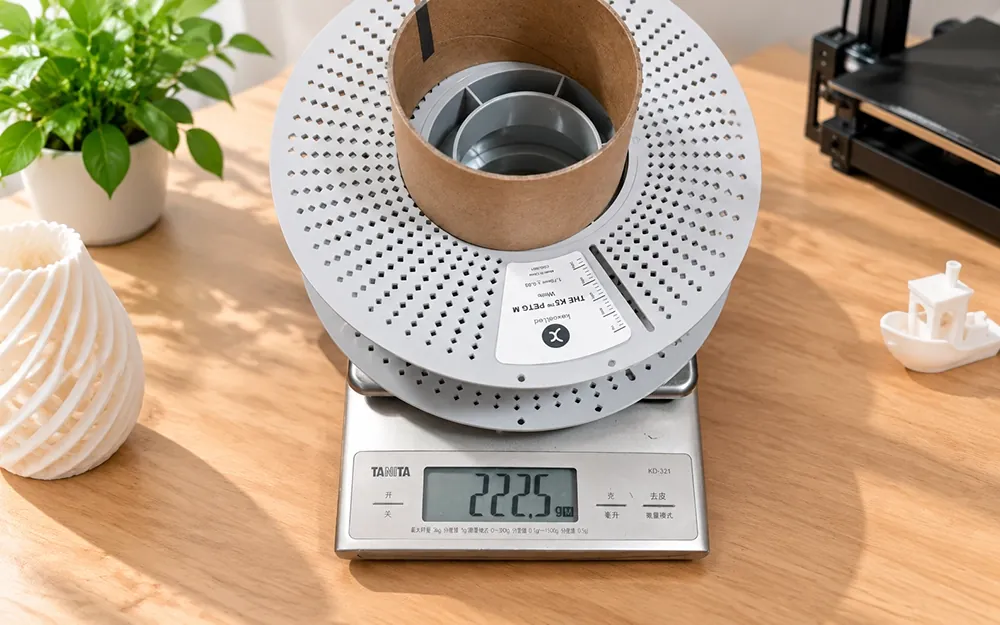
A 1 kg spool contains 1,000 g of net filament unless the label says otherwise. At 1.75 mm, usable length is usually around 330-340 m, depending on material density and true diameter.
Material comparison data
| Material | Diameter | Tolerance | Net weight | Data status |
|---|---|---|---|---|
| PLA | 1.75 mm | ±0.03 mm | 1 kg/spool | Complete |
| PETG | 1.75 ±0.02 mm | ±0.02 mm | 1 kg/spool | Partial |
| ABS | 1.75 mm or 3.0 mm | Not supplied | 1 kg/spool | Partial / verify |
| TPU | 1.75 ±0.02 mm | ±0.02 mm | 200 g / 500 g / 1 kg | Partial |
| PC | 1.75 mm or 3.0 mm | ±0.03 mm | 1 kg/spool | Partial |
Source: PIBUNO project material workbook and existing product templates. “Not supplied” means the project did not include a verified value; it is not an industry default.
Net weight versus gross weight
Net filament weight describes the plastic on the spool. Gross weight includes the spool, the box or other packaging.
A seller should state the net weight clearly. If two products both look like 1 kg spools, compare the net value rather than the shipping weight.
Why the length is approximate
Length depends on material density and the actual cross-section of the filament. A denser material gives fewer meters for the same mass.
The diameter tolerance also matters. A strand that is slightly larger contains more plastic per meter, so a 1 kg spool contains less length.
Use a calculation as an estimate, not as a substitute for weighing a finished part.
A useful conversion formula
For a round filament strand:
Meters = mass / (cross-section area × density)
Use grams in the numerator and grams per cubic centimeter in the denominator. Convert the cross-section to square centimeters.
You do not need to do this for every print. The slicer's material estimate is usually sufficient for a test. Use the formula when comparing spool formats or checking a supplier's stated length.
What about PETG and other materials?
PETG, ABS, PLA and TPU do not all have the same density. Their length per kilogram can differ. A label that states only “1 kg” does not tell you the same number of meters for every material.
The Pibuno PLA category gives a practical example of standard 1 kg products. The wholesale filament page covers bulk order formats.
Match the spool to the printer
A larger reel may reduce cartridges and spool changes, but it can be too wide for a printer cradle or dry box. Check:
- Outer diameter
- Spool width
- Center hole
- Reel material
- Maximum supported weight
For production, the handling system matters as much as the net weight.
Estimate print usage
Slice the model and note the estimated filament mass. Print one representative part. Weigh the part and any support that must be removed.
Use that measured result to estimate a batch. Add an allowance for purge, failed starts and color changes, but do not use a large generic percentage without checking the process.
If the part will be sold by unit, calculate the material cost from the actual part weight. Include waste in the production cost separately.
A worked length example
For any 1.75 mm strand, first convert the diameter to centimeters and calculate the circular cross-section. Then divide the filament mass by the volume represented by one meter.
The material density is the remaining input. PLA, PETG, ABS and TPU are not all equal, so a single meter figure should not be copied across every material family.
Keep the result labeled as an estimate. Real diameter variation and a partially empty spool change the usable length.
Calculate print length from the slicer
The slicer shows filament mass and often length for the complete job. Treat that output as a planning value for the selected profile.
A model with supports, purge towers or multiple colors uses more material than its solid volume suggests. The slicer can account for those features better than a manual volume estimate.
After a representative print, compare the estimate with the measured part and waste. This helps improve future planning for the same product.
Convert length across materials
A heavier material may contain fewer meters in the same net mass. Do not assume a PETG spool has the same usable length as a PLA spool merely because both are sold as 1 kg.
Use the material density from the exact supplier's current data sheet and the nominal diameter. Record the calculation assumptions with the product.
If the project is costed per part, material mass is usually the more direct purchasing input. Length matters when the slicer, printer or customer specifies a run requirement.
Plan bulk formats
Larger spools reduce changeovers but require more handling space. Check the holder, dry box, feed motor and emergency stop procedure.
For a print farm, calculate how many machines can run from one spool and how much downtime a change creates. A lower price per kilogram may not help if the format does not fit the system.
Include waste in the order plan
Production waste may include purge, support, failed starts and color changes. Use measured waste from the actual workflow.
Keep a small reserve for spool tails and operator error. Do not hide a large unknown allowance in the price with an unexplained assumption.
Verify the product label
Check nominal diameter, net weight, material and color on the spool and packaging. If the label conflicts with the order, stop before production.
Example order calculation
Suppose a customer needs 120 parts and the approved part uses 42 g of filament. The raw part estimate is 5,040 g.
Add measured purge, support and failed-start waste from a pilot run. If the pilot uses 4 g of waste per good part, the planning quantity rises by 480 g before any rejected parts are considered.
Then divide by the net filament weight per spool and round up to a practical purchase quantity. Keep the working in the order record so the buyer can see how the quantity was derived.
Avoid false precision
A slicer value can change when infill, support, purge or filament density changes. Report the result at a useful precision instead of implying hundredth-gram control.
Do not use the same part weight across materials without checking density and profile. A visual model may look identical while the material use differs.
Compare spool formats
| Format | Useful when | Main check |
|---|---|---|
| 1 kg plastic reel | Small batches and broad color ranges | Holder fit and storage space |
| 1 kg cardboard reel | Retail or lower packaging waste goals | Roller wear and moisture protection |
| 3-5 kg reel | Longer production runs | Holder strength and feed path |
| Custom packaging | OEM or retail programs | Label, carton and compatibility |
The spool material and hub need to work with the printer and dry box. A low-cost reel that rubs or deforms can stop a production run.
Check the winding
A tightly wound, even spool feeds more predictably than one with loose loops or embedded crossing strands. Inspect the first few meters and the outer edge.
Do not pull hard on a tangled end. Straighten the line and feed it under control; forcing it can create a tighter tangle deeper in the reel.
Unit conversion
If a supplier states length in feet and meters, preserve the original unit and show the conversion used. Do not add precision beyond the source.
For purchasing, keep net mass and length as separate fields. One may be needed by a printer workflow while the other is used for freight or packaging.
Ask before a large order
Confirm that the reel, hole and weight fit the actual machine. Ask for the outer dimensions and packed carton weight, especially when using a new bulk format for the first time.
Run one full spool change and a normal production part before ordering a large shipment. This catches handling issues that a short sample will not.
Reconcile the delivery
Compare the received net weight, reel size and label with the purchase order. Weigh a sample when the format is new or the supplier changes.
Record any shortage or packaging damage before the spool enters production.
Keep the calculation with the order
Store the slicer estimate, measured part weight, waste assumption and spool calculation in the purchasing file. A later repeat order can reuse the method without pretending the old estimate is still exact.
If the product changes, update the input values and check whether the chosen reel still gives a sensible number of spool changes. The answer should support the production schedule, not only the lowest material price.
Common mistakes
Do not compare a cardboard spool with a plastic spool by total shipping weight. Compare net filament.
Do not assume every 1 kg spool has an identical length. Material density and diameter affect it.
Do not store a large spool on a printer hanger that was designed for 1 kg. The load and inertia can damage the holder.
FAQ
Is 1 kg of filament exactly 1000 grams?
It should be 1,000 g net filament. Confirm the label and packaging definition before treating the number as an exact production quantity.
How many meters are in a 1 kg PLA spool?
Many 1.75 mm PLA products are in the range of approximately 330-340 m, but density and diameter make the exact value product-specific.
Does spool weight include the reel?
Net weight should not include the reel. Gross weight does. Ask which value is printed on the product page or label.
What size spool should a print farm use?
Choose a format that matches printer clearance, feed reliability, storage space and the expected number of spool changes. A wholesale supply plan can combine those factors across a product range.