

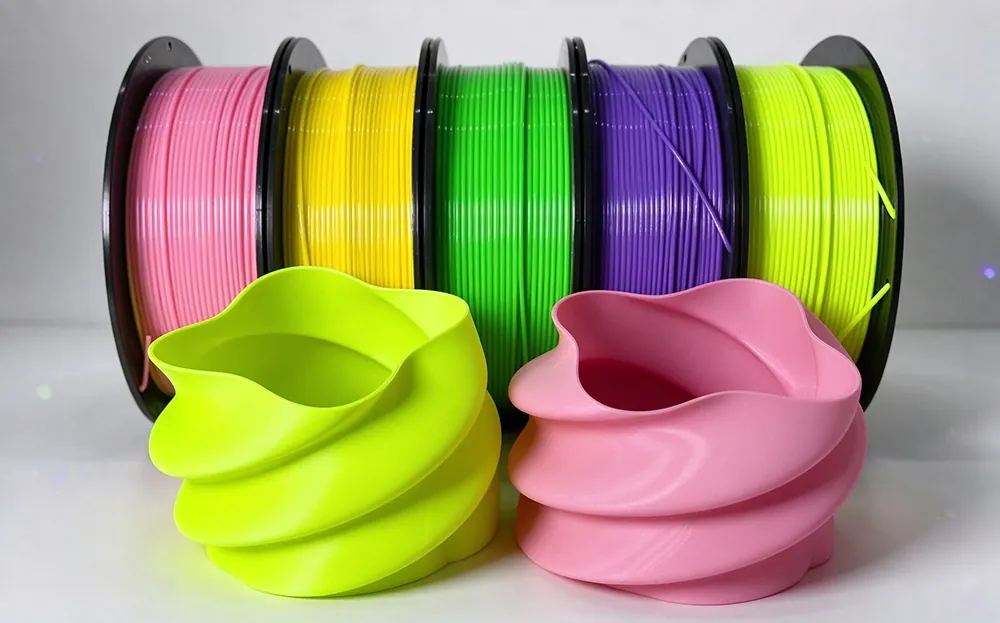
3D printer filament can be recycled by sorting clean plastic, shredding it into small pieces and extruding new filament. The practical limits are contamination, mixed colors and materials, degradation, and the cost of collecting and processing small amounts.
PIBUNO material data
| Parameter | PIBUNO supplied value |
|---|---|
| Material | PLA |
| Grade / effect | Standard PLA |
| Diameter | 1.75 mm |
| Diameter tolerance | ±0.03 mm |
| Net weight | 1 kg/spool |
| Density | 1.25 ±0.05 g/cm³ |
| Nozzle | 195–230°C |
| Bed | 0–60°C |
| Print speed | 40–60 mm/s |
| Layer height | 0.1–0.2 mm |
| Tensile strength | 60 MPa |
| Elongation at break | 3.0% |
| Flexural modulus | 1,900 MPa |
| Water absorption | 0.5% |
| Melt flow | 3–7 g/10 min at 190°C, 2.16 kg |
| Data status | Complete |
| Source note | Use 70–80°C bed only for the lattice-platform reference stated in the source. |
Source: PIBUNO project material workbook and existing product templates. “Not supplied” means the project did not include a verified value; it is not an industry default.
Start with sorting
Keep PLA, PETG, ABS and other materials separate. A small amount of the wrong polymer can change the recycled filament.
Remove supports, labels, metal inserts, rubber feet and dirt. A clean waste stream is more useful than a mixed box of broken prints.
What can be reused
Failed prints and purge material from a known material are easier to reprocess than mixed workshop waste.
Repeated heating can reduce molecular weight and change flow. Recycled filament may need a different print profile and can be more brittle.
The recycling steps
- Identify and sort the plastic.
- Remove contamination and moisture.
- Shred or grind it to a consistent size.
- Dry the flakes as required.
- Extrude and control diameter.
- Test a small sample before production.
The PLA material page shows how consistent virgin material is presented. Recycled material needs similar controls if it is going into a commercial product.
Quality checks
Test:
- Diameter
- Ovality
- Color
- Moisture
- Flow
- Brittleness
- Layer bonding
Use a short print coupon and a small functional part. Do not move directly from shredding to a large print.
Collection is the hard part
A recycling machine does not create a circular system by itself. A workshop needs enough clean material of one type, a way to transport it and a use for the recycled output.
For small users, local collection or a specialist recycler may be more practical than buying a filament extruder.
Product design helps
Design parts with less support and fewer mixed materials. Label material samples and keep scrap bins next to the printers.
The filament types guide helps teams keep material streams separate.
Is recycled filament cheaper?
Not always. Collection, sorting, drying, extrusion and quality checks cost time. The value may come from waste reduction, product storytelling or a closed internal loop rather than a lower filament price.
See the Pibuno PLA range and product catalog for comparison with standard production materials.
Identify the polymer correctly
The recycling route depends on the actual plastic. Do not mix PLA, PETG, ABS and unknown composites.
Check the spool label, purchase record and color. If the material is unknown, keep it out of a production recycling stream.
Prepare clean feedstock
Remove support material, metal inserts, labels, rubber parts and dirty sections. Large pieces may need cutting before shredding.
Dry the flakes if the polymer requires it. Moisture can create bubbles and unstable extrusion.
Control the extrusion
The recycled strand needs controlled diameter, cooling and winding. Measure diameter at the start, middle and end of the run.
Test a short print before winding a full spool. Inspect flow, surface, brittleness and layer bonding.
Understand degradation
Each heat history can change the polymer. A recycled batch may need lower speed, different temperature or a non-critical application.
Do not use an unverified recycled batch for a safety-critical or load-bearing part.
Recycling system design
A workshop needs:
- Separate collection bins
- A clear material identification method
- A shredding and drying process
- Diameter measurement
- A test print
- A destination for the recycled output
Small volumes may not justify the equipment. A specialist recycler can be more practical.
Commercial products
If the recycled material supports a product claim, keep batch records and test results. The customer should know whether the part is decorative, functional or only suitable for a non-critical application.
Recycled material needs clear grade and performance information, especially when the finished product is sold rather than used internally.
Calculate a realistic yield
The output mass is lower than the collected scrap after trimming, contamination removal and failed extrusion.
Measure the mass that becomes usable filament. Include the energy and labor needed for drying, grinding and testing.
Choose the right use
Start recycled material in non-critical prototypes, fixtures or decorative samples. Prove repeatability before using it for a customer-facing structural part.
Keep color batches separate if appearance matters. Mixed scrap can produce a visually inconsistent spool even when the polymer is clean.
Make claims carefully
“Recycled” should identify the source and material. Do not imply closed-loop recycling if the material leaves the workshop.
Keep collection and output records if the recycling story appears in marketing.
Build a small pilot
Process one known material through the full workflow before collecting mixed scrap.
Record input mass, output mass, diameter, print result and failures. The pilot shows whether the workshop can produce a useful material consistently.
Protect workers and equipment
Shredding and extrusion create noise, dust, heat and moving-part hazards. Follow equipment instructions and local safety requirements.
Keep moisture and contamination out of the process. A wet or dirty feedstock can waste an entire batch.
Compare with virgin material
The Pibuno product catalog shows the clarity and consistency expected from production materials. Recycled material should be described with its actual grade and limits.
Use virgin or controlled material where the part needs repeatable strength, color or regulatory status.
Measure the process
Track input mass, output mass and rejects. A recycling process that produces inconsistent diameter is not ready for critical printing.
Dry and label the output spool as clearly as a new product.
Set a use policy
Define which products may use recycled material and which require virgin grade.
Keep customer and safety requirements above the desire to reduce waste.
Communicate the limits
Do not call a prototype “closed-loop” unless the material actually returns to a controlled production cycle. State the source, grade and tested use.
Compare scrap strategies
Reusing purge internally, sending clean scrap to a recycler and buying recycled feedstock are different options.
Choose the route based on volume, material identification and the quality requirement. A small studio may not have enough consistent scrap for extrusion.
Test the finished spool
Measure diameter through the spool and print a dimensional coupon. Check for bubbles, weak layers and color variation.
Keep the recycled spool label separate from virgin stock. Mixing them creates a traceability problem.
Cost the labor
Sorting, grinding, drying, extrusion and testing take time. Include those steps when comparing recycled output with new filament.
The value may come from waste reduction or an internal product story rather than a lower unit price.
Set acceptance limits
Define allowable diameter variation, contamination and print defects. Reject a batch that cannot meet the application.
Do not mix recycled output into virgin inventory without a clear label.
Review the environmental claim
Measure what actually happens to the waste. A local recycler, an industrial composter and a landfill are different end-of-life paths.
The article should describe the available route rather than implying a universal solution.
Train the team
Labels and collection bins only work when everyone uses them. Make material separation part of the printer workflow.
Review mistakes before they contaminate a larger batch.
Store the recycled spool correctly
Dry the output and seal it with a label that identifies the source and date. Keep it away from virgin stock.
Print a test before using the spool for a customer job.
Compare the output with the requirement
Use the PLA material page as a reminder of the information a controlled product needs: material identity, diameter and intended processing.
Recycled material can be useful without matching virgin material everywhere. State where it is suitable and where it is not.
Keep the output out of a vague waste stream
Recycled filament needs a named material, source and test result. If those cannot be established, use the material only in non-critical work or remove it from production.
The production team should know which spool is recycled and which is virgin.
Keep separate storage and printer records so a customer part is not made from an unapproved recycled lot by mistake.
Keep the batch traceable
Record the input material, output spool, diameter and test print. A recycled batch without traceability should not enter a customer production order.
Keep the recycling record
The input material, output spool and test result should be stored together. A future operator should know whether the recycled filament is approved for visual, functional or prototype work.
Recycled spools should carry the same material and batch information as new stock.
An operator should not have to infer whether a reel came from virgin polymer, clean workshop scrap or an unverified source.
Keep a simple log from collection to the finished spool. If a customer asks about the material, the answer should be supported by that record rather than a verbal estimate.
FAQ
Can all 3D prints be recycled?
No. Material type, contamination and local recycling capability matter.
Can failed prints be turned into filament?
Yes in some workshops, but the material must be sorted and tested for diameter, moisture and brittleness.
Is PLA biodegradable in a home compost bin?
PLA usually needs specific industrial composting conditions. Do not assume it will disappear in ordinary soil or a backyard pile.
Is recycled filament as strong as new filament?
It can be, but repeated processing and contamination may reduce quality. Test the actual batch.