

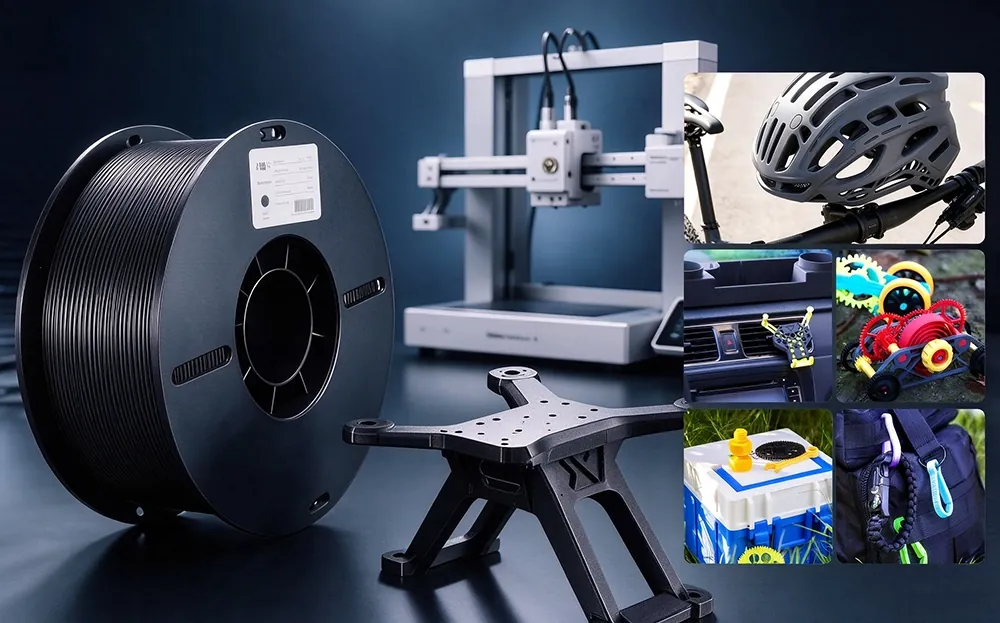
ABS is a styrene-based engineering filament with good impact resistance and higher heat tolerance than standard PLA. It is not the easiest material to print, but it remains useful for durable indoor parts and established engineering workflows.
PIBUNO material data
| Parameter | PIBUNO supplied value |
|---|---|
| Material | ABS |
| Grade / effect | Black / White ABS |
| Diameter | 1.75 mm or 3.0 mm |
| Net weight | 1 kg/spool |
| Density | 1.04 ±0.5 g/cm³ as supplied |
| Nozzle | 230–250°C |
| Bed | 70–90°C |
| Print speed | 30–50 mm/s |
| Tensile strength | ≥43 MPa |
| Elongation at break | ≥10.0% |
| Flexural modulus | ≥60 MPa |
| Water absorption | 1% |
| Melt flow | 2–4 g/10 min at 190°C, 2.16 kg |
| Data status | Partial / verify |
| Source note | The supplied density tolerance reads ±0.5 and the flexural-modulus value reads ≥60 MPa; verify both against the current grade before publication. |
Source: PIBUNO project material workbook and existing product templates. “Not supplied” means the project did not include a verified value; it is not an industry default.
What ABS filament is
ABS stands for acrylonitrile butadiene styrene. The three components contribute different properties, including toughness, heat resistance and processability.
The raw polymer is not the only thing in a spool. Colorants and additives can change strength, flow and surface finish.
Where ABS fits
ABS can suit:
- Indoor housings
- Functional prototypes
- Jigs and fixtures
- Appliance components
- Parts that need more heat resistance than PLA
- Components that may receive moderate impact
The Pibuno ABS category shows the available range and related material direction.
Heat and impact
ABS generally handles warmer conditions than PLA and can absorb impact better than a brittle standard PLA part. It is not automatically suitable for permanent outdoor use or extreme temperature.
For UV and weather exposure, compare ASA on the Pibuno ABS and ASA page. The ASA vs ABS guide explains when the outdoor-focused material is a better starting point.
Printing requirements
ABS usually needs:
- A hot nozzle and bed
- Controlled cooling
- Protection from drafts
- Secure bed adhesion
- A stable chamber for large parts
- Appropriate ventilation
Warping is common when the part cools unevenly. Large flat areas and sharp corners are more difficult than small thick shapes.
Fumes and workspace
Printing can produce odors and emissions. Use an appropriate workspace, follow the printer and material instructions, and do not assume an enclosed printer eliminates exposure.
Bed adhesion
ABS can stick well to suitable sheets and slurries, but aggressive adhesion or excessive squish can damage the surface. Follow the printer and material guidance.
Use a brim or different orientation when the geometry needs more hold. A larger brim is not always the answer; temperature and draft control often matter more.
ABS versus PLA
PLA is easier and better for detailed display work. ABS is tougher in many functional applications and handles more heat.
Choose ABS only when its benefits support the added print-control requirements.
Product checks
Confirm:
- Grade and color
- Diameter tolerance
- Net weight
- Recommended process range
- Spool format
- Drying and storage instructions
For related engineering materials, see the engineering filament category and filament types guide.
What ABS offers
ABS combines useful impact resistance with a higher heat tolerance than standard PLA. It is a familiar engineering plastic that can be machined, sanded, bonded and painted with suitable processes.
The printed part is not identical to a molded specimen. Layer direction, infill, temperature and moisture control affect strength and appearance.
A practical printing profile
Many ABS products use a nozzle around 230-260 C and a bed around 90-110 C. The exact grade and printer determine the valid range.
Start with a small enclosure-shaped part. Watch corners, flat bases and layer bonding. Use a stable chamber and limit drafts.
Do not add an oversized brim to hide poor first-layer settings. Correct level, nozzle height and bed temperature first.
Warping
Warping occurs when layers cool at different rates. Long flat sections and sharp corners are more demanding than small compact shapes.
Try a more stable orientation, rounded corners and controlled cooling. Let the part cool gradually before removing it from the build plate.
For a large production part, print a representative geometry before approving the material. A small cube cannot show the warping behavior of a broad cover.
Ventilation and workspace
ABS can produce odors and emissions during printing. Use an appropriate workspace and follow printer and material safety instructions.
An enclosure helps control temperature, but it does not automatically make the air safe. Plan ventilation separately from print stability.
Compare ABS with other materials
| Alternative | Choose when |
|---|---|
| PLA | Easy display part with low heat exposure |
| PETG | More toughness with easier open-printer processing |
| ASA | Better outdoor UV and weather exposure |
| PC | Higher heat and impact demand with more printer capability |
The ASA vs ABS guide focuses on weather and UV. The PLA vs PETG guide covers the easier everyday materials.
Common uses
ABS can fit indoor housings, prototypes, fixtures, appliance parts and durable covers.
It is not the default choice for every “strong” part. A nylon or PC grade may be better for repeated impact, heat or wear.
Design for robust printing
Avoid very large uninterrupted flat areas. Add ribs and fillets for stiffness, and use a sensible wall count.
Give screw bosses enough thickness and test them with the real fastener. Layer bonding at the boss may be weaker than the material data suggests.
Technical source note
Mechanical, thermal and print properties vary by grade. Use the exact supplier data sheet and a representative printed test; do not convert a generic ABS claim into a Pibuno product guarantee.
ABS vs PETG and ASA
PETG is often easier on an open printer and can produce translucent surfaces. ABS can support higher heat and different impact behavior.
ASA is the better starting point for long outdoor exposure. The ASA vs ABS comparison explains the weather distinction.
Do not choose ABS only because a part needs to be “strong.” Define heat, impact, weather and dimensional requirements.
Qualification plan
Print a test enclosure with corners, a screw boss and a flat base. Use the production printer and enclosure.
Check warping, dimensions, layer bonding and odor in the workspace. Apply the planned fastener and test the joint.
If the sample fails, change orientation, design or process before assuming a different ABS grade will solve it.
Sourcing ABS
Request grade, color, diameter, net weight, spool type and recommended print range. Keep the approved sample and lot information.
Ask about storage and drying. ABS can absorb moisture, and a wet spool may pop or extrude unevenly.
A practical ABS approval
Start with a representative part that includes a corner, a flat base, a screw boss and a short bridge. Print it in the intended orientation with the production printer.
After cooling, inspect warping, layer bonding, dimensions and surface. Install the intended insert or fastener and check the joint.
If the part fails, change one cause at a time. A new material is not the first response to a draft, wrong bed height or incorrect profile.
Storage and repeatability
Keep ABS dry and away from excessive heat. Record the lot and profile used for the approved sample.
When a new batch arrives, compare it with the retained part and the material label. Changes in color, diameter or flow should be reviewed before production.
Final decision checklist
Confirm that the printer can hold the temperature, the workspace is suitable for the process, and the part has been tested in the intended orientation.
Choose PETG or ASA when their specific advantages matter more than ABS. Keep the material choice tied to the product's heat, impact and weather requirements.
The Pibuno ABS page and engineering catalog are the product references; the final approval should use the tested part.
When to pause the order
If the sample warps, the printer cannot hold the chamber, or the workspace lacks suitable ventilation, pause the order instead of increasing quantity.
The correct material still needs a controllable process. A change to ASA, PETG or another grade may be the simpler production choice.
Review the sample from all sides
Check the base, walls and top surface. Look for cracks that start at corners or screw bosses.
Measure the largest flat area after cooling, not only the smaller feature that is easy to reach.
Confirm repeatability
Print a second part with the same spool and profile. If the result changes, resolve the machine or environment issue before scaling.
Store the approved sample and note the material lot. A repeat order should start from the same evidence.
Check the final assembly
Test the printed part with the actual insert, fastener and mating component. A standalone sample may pass while the assembly fails at a thin boss or an over-tightened joint.
Record the torque or assembly method when a repeat order must reproduce the result.
If the joint changes, repeat the thermal and load test before approving the new assembly.
The final record should show the exact part, material and condition that passed.
Keep a second approved part available for comparing a future production lot.
The approved sample should show the intended color and surface, not a lab-only coupon.
Store the part in a protective bag and record the printer and material lot used.
That record makes later dimensional and surface checks meaningful.
The approved ABS record should remain available when the next lot arrives.
FAQ
Is ABS stronger than PLA?
ABS is generally tougher and handles higher heat, while PLA is stiffer and easier to print.
Does ABS need an enclosure?
An enclosure helps control drafts and temperature, especially for large parts. Follow the printer maker and filament maker guidance.
Can ABS be used outdoors?
It can in some conditions, but ASA usually offers better UV and weather resistance.
Is ABS food safe?
Do not treat ABS as food safe without documentation for the exact grade, print process and intended use.