

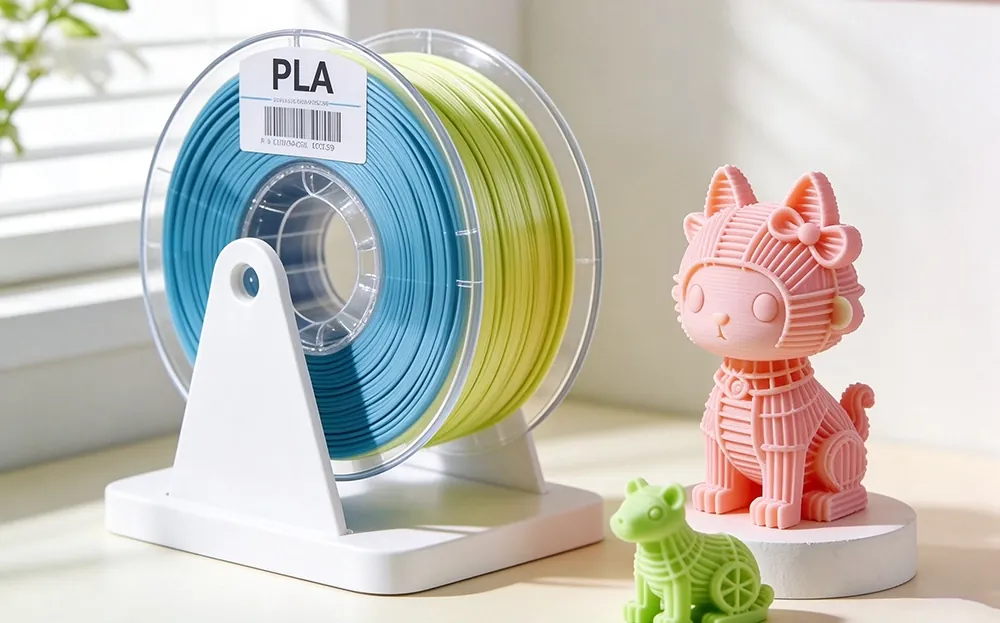
PLA is a thermoplastic polyester made from renewable feedstock such as corn starch or sugarcane. It is popular because it prints easily and produces clean detail, but its heat resistance and outdoor durability are limited.
Material comparison data
| Material | Diameter | Density | Nozzle | Bed | Print speed | Key mechanical data |
|---|---|---|---|---|---|---|
| PLA | 1.75 mm | 1.25 ±0.05 g/cm³ | 195–230°C | 0–60°C | 40–60 mm/s | Tensile 60 MPa; Elongation 3.0%; Flexural 1,900 MPa |
| PLA+ | 1.75 ±0.02 mm | 1.25 g/cm³ | 200–230°C | 45–65°C | 200–400 mm/s | Not supplied |
Source: PIBUNO project material workbook and existing product templates. “Not supplied” means the project did not include a verified value; it is not an industry default.
What PLA filament is
Polylactic acid is a plastic that can be melted and extruded in an FDM printer. The raw polymer is combined with colorants and additives to make a finished filament product.
“PLA” is a material family, not one exact recipe. Standard PLA, PLA+, high-speed PLA and effect PLA can behave differently.
Why PLA is popular
PLA offers:
- Easy printing on many open printers
- Clean detail and sharp edges
- A wide color range
- Moderate stiffness
- Low odor compared with some engineering plastics
It suits models, signs, prototypes, decorative objects and educational prints.
Where PLA should not be used
Standard PLA has low heat resistance. A part left in a hot car may soften, warp or lose fit. PLA is also generally less suitable for long outdoor exposure or a load that requires high toughness.
If the part needs more impact resistance or heat resistance, compare PETG and the ABS and ASA range.
PLA types
Standard PLA
The general-purpose option for models, color and easy processing.
PLA+
PLA+ usually describes a modified product with improved toughness or print behavior. Confirm the exact formulation rather than assuming every brand changed the polymer in the same way.
High-speed PLA
High-flow versions can support faster printers and production work. Check the recommended volumetric flow and profile.
Effect PLA
Silk, matte, rainbow, wood, marble, glow and other effects change appearance. Their additives can affect printing, so use the exact product profile.
Pibuno's PLA category groups these product directions.
PLA print settings
A common starting point is about 190-220 C at the nozzle and 50-60 C on the bed. The PLA temperature guide explains how to test the actual spool.
Strength
PLA is stiff. Thin parts can hold shape well, but the material may crack under a strong impact. Layer direction and part design remain important.
If the part needs a combination of stiffness, toughness and heat resistance, no material wins automatically. Define the load and service temperature first.
Storage
PLA absorbs less moisture than nylon in many conditions, but it should still be kept dry and away from heat. The filament storage guide covers containers and handling.
Purchasing checklist
Confirm:
- Net weight
- Diameter tolerance
- Color standard
- Standard, PLA+ or effect grade
- Spool dimensions
- Print range
- Packaging
The filament types guide compares PLA with the wider material range.
How PLA behaves during printing
PLA melts at a lower temperature than many engineering polymers. Most open printers can process standard PLA with a moderate bed temperature and strong part cooling.
The material is stiff after cooling, which helps models and dimensional patterns. Its lower heat tolerance is the main limitation for service parts.
Color and additives can change flow. Silk PLA may print with a different surface and stringing behavior even though the base family is still PLA.
PLA product types
| Type | What it is used for | Main check |
|---|---|---|
| Standard PLA | Models, signs and general prototypes | Color and heat exposure |
| PLA+ | Parts that need more toughness or easier processing | Exact modified formulation |
| High-speed PLA | Fast printers and repeat production | Flow rate and layer bonding |
| Silk PLA | Decorative glossy parts | Surface and temperature |
| Matte PLA | Low-glare product surfaces | Color and layer appearance |
| Wood or marble effect | Visual natural finishes | Nozzle and surface behavior |
The product family helps narrow the choice. It does not remove the need for a print test.
Strength and heat limitations
PLA can be stiff and dimensionally stable at room temperature. It is also brittle under some impacts and may creep under a sustained load.
Heat resistance depends on the exact grade and part conditions. Do not place a standard PLA part where it will be exposed to direct sun, a hot car or a heated machine surface unless it has been tested.
For a functional bracket, consider PETG, ASA, PC or nylon based on the actual load and environment. The best filament guide explains the selection process.
A starting print profile
Many PLA profiles use a nozzle around 190-220 C, a bed around 50-60 C and moderate to high part cooling.
Start with the exact spool range. Print a first-layer patch and a small temperature tower before tuning flow.
Keep the bed clean and avoid excessive first-layer squish. For high-speed printing, check the hot-end flow capability and use a material designed for that process.
Post-processing
PLA can be sanded, filled, painted and bonded, but each process changes the surface.
Test adhesives and coatings on scrap. A solvent that softens the surface may be difficult to control on a thin wall.
Sand progressively rather than pressing hard in one area. Uneven pressure can distort small features before the surface is ready for paint.
Recycling and biodegradability
PLA is often described as biodegradable, but ordinary disposal is not the same as industrial composting.
The printed part also contains colorants and may be combined with other materials. Check the local waste system and request the exact material documentation.
The PLA recycling article explains the difference between recycling, industrial composting and landfill.
Storage and shelf life
Keep PLA dry and away from heat. It is often less sensitive than nylon, but a humid storage room can still cause popping or rough extrusion.
Heat exposure can soften or deform a spool before printing. Store it in a shaded area and use the filament storage guide when repeatability matters.
How to qualify PLA
Print a representative model with the final color and profile. Measure detail, dimensions and surface. Keep a reference sample and the spool identifier.
Repeat the test for a new color, additive or supplier. A generic PLA label does not guarantee the same flow or finish.
Use PLA for the right kind of part
PLA is a strong fit for display pieces, architectural models, gifts, prototypes and short-life indoor parts.
It can work for functional fixtures when the load and temperature are modest. It is usually the wrong place to start for hot equipment, outdoor exposure or repeated impact.
The best filament guide compares PLA with PETG, ASA and other families by application.
Diagnose common PLA print defects
Weak layers can point to low temperature, high speed, moisture or insufficient cooling. Stringing can come from a high nozzle temperature or too little travel.
Rough first layers often indicate bed condition or nozzle height. A partial clog can make the part look under-extruded on one side.
Change one variable and keep a labeled sample. This turns a pile of test prints into usable process evidence.
Make the purchase decision
Choose a color and finish, then select the process category: standard, high-speed, PLA+ or effect PLA.
Confirm diameter tolerance, spool dimensions, net weight and recommended drying. Ask for a physical sample when color consistency matters.
When PLA is the wrong choice
PLA is a poor default for hot equipment, permanent outdoor use or a part that needs repeated impact. It can also creep under a sustained load at temperatures that seem moderate.
If the part must survive a warm car, direct sun or a heated enclosure, test the actual geometry before approving it. A material change to PETG, ASA, PC or another grade may be more appropriate.
Quality checks before ordering
Check the color in printed form, not only on the spool. Verify diameter tolerance, net weight, spool dimensions and the recommended print range.
Ask how the supplier identifies the material and lot. A label that remains readable after storage helps the operator use the correct profile.
Keep a reference print with the approved spool. The reference can reveal a new color shift or surface change that a specification sheet misses.
Set the right application boundary
PLA works when appearance, detail and predictable printing matter more than heat or outdoor life. If the product will be left in a hot car, near a heater or used outdoors, choose a material that matches the actual exposure.
Test the complete part before assuming a generic PLA grade fits the job.
For a product that will be handled, dropped or left in a warm room, use the expected failure test rather than relying on the PLA label.
This is why PLA selection should begin with the service condition and end with a retained printed sample.
The same material can be ideal for one application and unsuitable for another.
This distinction prevents a material name from replacing an application test.
FAQ
What is PLA made of?
PLA is polylactic acid, commonly made from fermented plant sugars. The finished filament also contains additives and colorants.
Is PLA strong?
It is stiff and can be strong for many models, but it is not the best choice for high impact or high heat.
Is PLA biodegradable?
PLA can biodegrade under specific industrial conditions. It should not be treated as safe to discard in any outdoor environment.
Is PLA easy to print?
Yes for many printers, but the exact color, additive and printer profile still matter.