

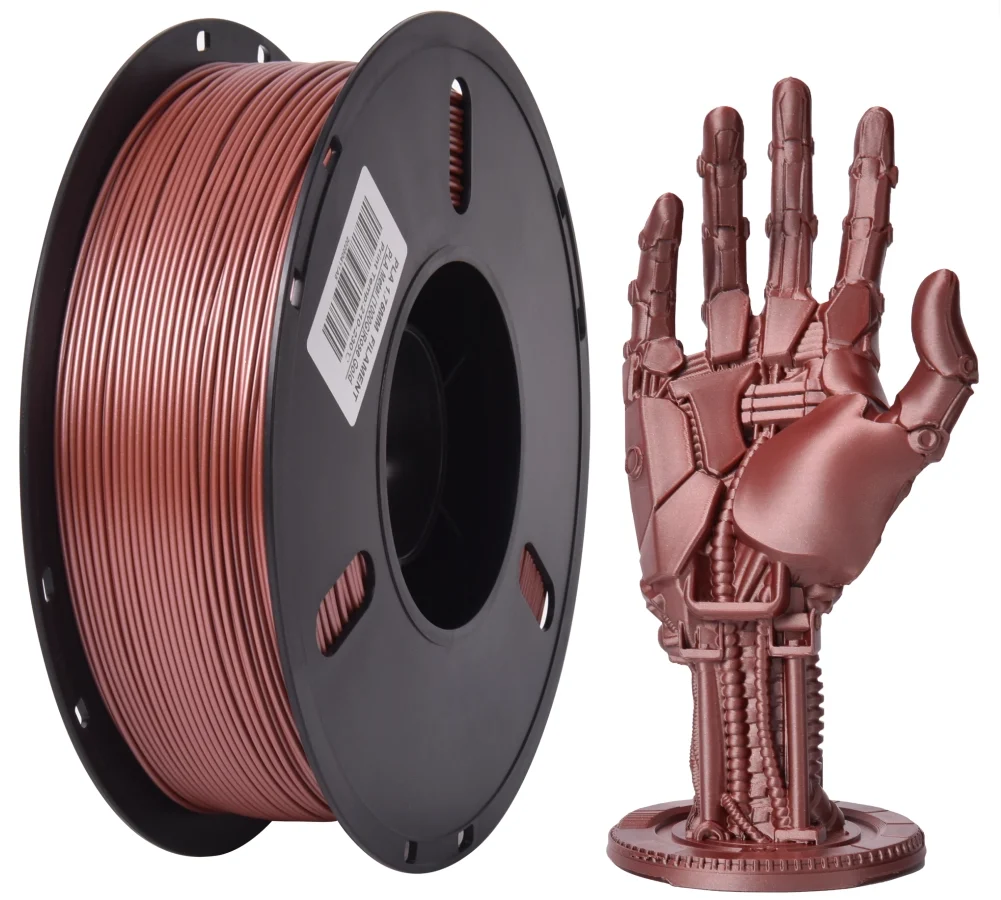
3D printer filament usually costs from roughly tens of dollars for a standard 1 kg consumer spool to hundreds of dollars for high-temperature or specialty materials. The material, grade, weight, color, tolerance, packaging and order quantity explain most of the difference.
Material comparison data
| Material | Density | Nozzle | Bed | Print speed | Key mechanical data | Data status |
|---|---|---|---|---|---|---|
| PLA | 1.25 ±0.05 g/cm³ | 195–230°C | 0–60°C | 40–60 mm/s | Tensile 60 MPa; Elongation 3.0%; Flexural 1,900 MPa | Complete |
| PETG | 1.27 g/cm³ | 220–250°C normal; 240–250°C high-speed | 60–80°C | 40–60 mm/s normal; 150–200 mm/s high-speed | Elongation 10%; Flexural 2,060–2,160 MPa | Partial |
| ABS | 1.04 ±0.5 g/cm³ as supplied | 230–250°C | 70–90°C | 30–50 mm/s | Tensile ≥43 MPa; Elongation ≥10.0%; Flexural ≥60 MPa | Partial / verify |
| TPU | Not supplied | 215–235°C | 0°C or 60–80°C | 20–40 mm/s | Not supplied | Partial |
Source: PIBUNO project material workbook and existing product templates. “Not supplied” means the project did not include a verified value; it is not an industry default.
What changes the price
| Cost factor | Effect |
|---|---|
| Polymer | Engineering and high-temperature materials cost more |
| Additives | Carbon fiber, flame retardants and special effects add cost |
| Color | Small custom batches usually cost more per spool |
| Diameter control | Tighter production tolerances require more process control |
| Spool and packaging | Retail boxes, labels and custom reels add cost |
| Order quantity | Bulk orders spread setup and packaging costs differently |
Two products may both say “PLA,” yet use different grades, colorants and packaging.
Price per usable part matters
A $20 spool is not automatically cheaper than a $30 spool. Failure rate, purge waste, print speed, support material and labor affect cost per good part.
Use this estimate:
Material cost per part = part weight × cost per gram
Then add:
- Support and purge waste
- Failed-print allowance
- Spool changes
- Packaging
- Inspection
- Storage
For a production part, test the actual material and profile before setting a unit cost.
PLA and PETG
Standard PLA and PETG are common volume materials. PLA often benefits from a broad color range and easy printing. PETG may cost a little more when better toughness or transparency is required.
Compare the Pibuno PLA range and PETG range by product specification rather than color photo alone.
Engineering materials
ABS, ASA, PC, nylon and reinforced blends can cost more because the polymer, processing requirements and quality controls are more demanding.
The engineering filament category shows the material families that fit tougher applications.
Wholesale pricing
Bulk pricing depends on:
- Total quantity
- Material and color mix
- Spool size
- Label and packaging
- Sample approval
- Repeat-order forecast
- Delivery schedule
A quote can be misleading if it compares different net weights or packaging.
See wholesale filament options for the purchase structure and the product catalog for material formats.
How to compare quotes
Ask each supplier for the same data:
- Net weight
- Material grade
- Diameter and tolerance
- Color reference
- Spool size
- Packaging
- Sample process
- Batch and delivery terms
Then compare the landed cost and the cost per usable part.
Why the cheapest spool can cost more
A low-cost spool can create more failed prints, color rejects or moisture problems. That cost appears later in labor and scrap.
For repeat business, a stable product with documented specifications is often more valuable than the lowest first quote.
Calculate the material cost of one part
Start with the measured mass of a good finished part. Add support, purge and the measured waste from the production process.
Multiply the total material mass by the approved cost per gram. Keep packaging and labor separate so the reader can see which part changes with filament price.
For example, if a finished part weighs 40 g and the process uses 5 g of purge and support, the planning mass is 45 g. At a known cost per gram, the material contribution is 45 times that rate.
The example does not include a price, because the actual quote depends on material, order quantity and delivery terms.
Account for failed prints
A failed print consumes filament, machine time and operator attention. Track the failure rate by process stage.
Start failures, adhesion failures, clogs, color changes and end-of-spool interruptions have different causes. A single average failure percentage hides where the money goes.
Use a pilot run of the actual part. Count good parts and material consumed, then calculate the material needed per acceptable unit.
Compare material densities
Two 1 kg spools have the same net mass but not necessarily the same length. PLA, PETG, ABS and TPU can have different densities.
When a slicer estimates length, compare products using the same material assumptions. A cost per meter is not interchangeable with a cost per kilogram across different polymers.
For purchasing, net mass is usually the clearest common unit. For machine planning, the slicer estimate and measured use are more useful.
Packaging and order quantity
Custom labels, boxes, barcodes and cartons add cost. Larger order quantities may spread setup costs, but storage and freight also increase.
Ask whether the quote includes:
- Individual box
- Label design and proofing
- Outer carton
- Palletization
- Samples
- Freight and delivery terms
- Payment terms
A lower filament rate with extra packaging charges may not be the lower landed cost.
Build a comparable quote table
| Field | Required answer |
|---|---|
| Material and grade | Exact product family and color |
| Net weight | Grams per spool |
| Diameter tolerance | Nominal value and allowed range |
| Spool | Size, material and hub |
| Packaging | Individual and outer pack |
| MOQ | Minimum order quantity |
| Sample | Available sample and approval process |
| Delivery | Lead time, Incoterm and destination |
Use the same fields for every supplier. Otherwise the lowest number may represent a smaller or less complete product.
Hidden production costs
A cheaper spool can create more failed parts or slower tuning. It can also cause extra spool changes, poor winding or inconsistent color.
Calculate the cost of good parts, not only the cost of buying filament. This is the number that connects purchasing to the production result.
Price changes
Polymer and freight markets change. Keep the date, currency and validity period on a quote.
Do not publish an outdated example as a current Pibuno price. If an article needs a price, use an explicit example or an approved current range with its date.
What a buyer should compare
For a standard material, compare:
- Net weight
- Exact grade and color
- Diameter control
- Spool compatibility
- Packaging
- Sample approval
- Lead time
- Repeat-order control
The Pibuno product catalog can help identify the material family, but the final cost comparison belongs in a current quotation.
Work through a batch example
Suppose a batch requires 200 good parts. A measured part weighs 38 g, and the pilot run uses 4 g of support and purge per good part.
The planning mass is 42 g per part, or 8,400 g for the batch. If the pilot fails one in twenty parts, the required input rises again.
Use the current spool price and package format to calculate the number of spools. Then add packaging and labor from actual quotes.
The numbers show the method, not a market price. Update the inputs whenever the product or supplier changes.
Review the calculation boundaries
Do not apply a part weight from one material to another without checking density and print settings. Do not assume the entire spool is usable if the end is damaged or the feeder cannot reach the last section.
Keep the waste estimate separate from the material price. That makes it easier to see when a cheaper spool is not producing a lower cost per good part.
Include freight and inventory
The delivered cost includes transport, duties, storage and financing. A lower material price may lose its advantage when a shipment requires more space or a longer lead time.
For a first order, request the packed volume and carton weight with the indication. Confirm the destination, delivery term and who handles import charges.
Separate product cost from process cost
The filament, spool and packaging form one cost group. Drying, machine time, failed prints and operator handling form another.
When two products use different print speeds or reject rates, compare the complete production result. A lower-cost spool that runs slower may not reduce the unit cost.
Update quotes
Keep the quote date and validity period. Polymer and freight conditions change, and an old number should not be presented as current.
If a public price example is necessary, label it as an example and state the material, quantity and date. Do not imply that it is a Pibuno quote.
Record the basis of comparison
Save the quote, quantity break, packaging specification and delivery date. A future comparison should use the same fields.
When a product changes, recalculate the part weight and waste instead of carrying forward the old cost. This keeps the purchasing decision tied to the current production job.
Compare the latest quote against the approved supplier specification, not only the headline price.
Keep the quote and sample file under the same project identifier so future changes can be audited.
Use the same project file when packaging or a material color changes.
Keep the price date and quantity visible on the face of the comparison.
Review the same fields before accepting a repeat quotation.
Keep the revised date attached to the new calculation.
FAQ
How much is a 1 kg roll of PLA?
Consumer prices vary widely by grade, color, packaging and market. Use net weight, diameter tolerance and printed quality to compare products, not price alone.
Why is carbon fiber filament more expensive?
The composite material, abrasion requirements and tighter process control can add cost.
Is bulk filament cheaper?
Bulk can reduce cost per kilogram, but packaging, color mix, freight and quality requirements affect the final price.
How do I estimate filament cost for a product?
Measure the finished part and waste from a representative print, then multiply the material mass by the approved cost per gram.