

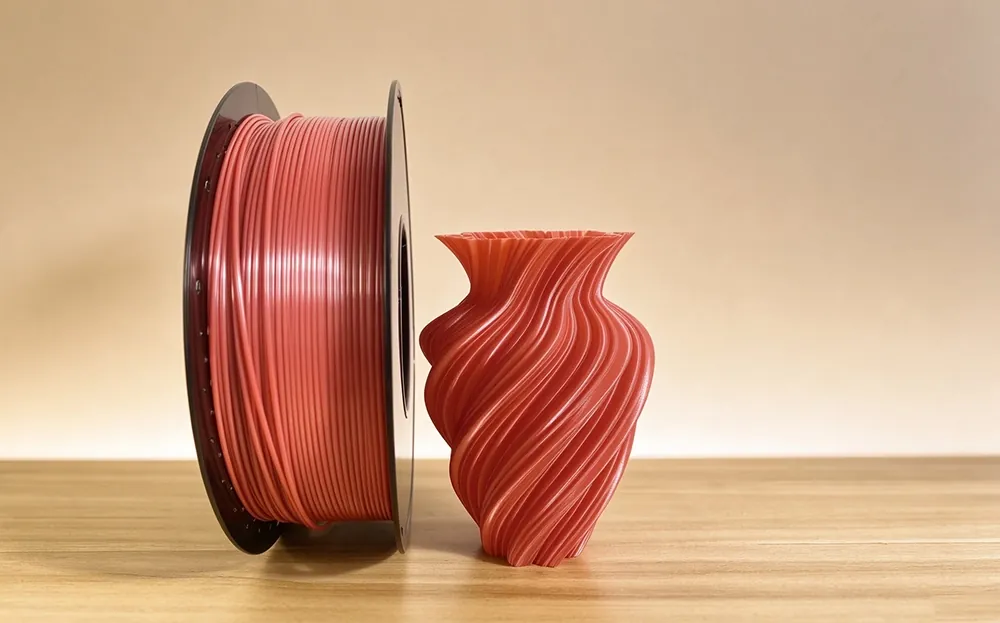
PETG is a glycol-modified polyester filament that balances toughness, moderate heat resistance and clarity. It is often easier to print than ABS while offering less brittleness than standard PLA.
PIBUNO material data
| Parameter | PIBUNO supplied value |
|---|---|
| Material | PETG |
| Grade / effect | Standard PETG |
| Diameter | 1.75 ±0.02 mm |
| Diameter tolerance | ±0.02 mm |
| Net weight | 1 kg/spool |
| Density | 1.27 g/cm³ |
| Nozzle | 220–250°C normal; 240–250°C high-speed |
| Bed | 60–80°C |
| Print speed | 40–60 mm/s normal; 150–200 mm/s high-speed |
| Layer height | 0.2 mm reference |
| Heat deflection | 70°C |
| Elongation at break | 10% |
| Flexural modulus | 2,060–2,160 MPa |
| Data status | Partial |
| Source note | High-speed values require a compatible high-flow printer and profile. |
Source: PIBUNO project material workbook and existing product templates. “Not supplied” means the project did not include a verified value; it is not an industry default.
What PETG stands for
PETG means polyethylene terephthalate glycol. The glycol modification changes how the polymer crystallizes and makes it suitable for filament printing.
It is not the same as the PET used in beverage bottles. Similar names do not mean the print behavior or finished properties are identical.
Where PETG works well
PETG is a practical starting point for:
- Brackets and mounting plates
- Covers and housings
- Guards and protective parts
- Semi-transparent light covers
- Parts that need some impact resistance
- Functional prototypes that stay below its heat limit
The Pibuno PETG category shows standard, matte and related product directions.
What PETG does well
PETG is usually tougher and less brittle than standard PLA. It can flex under moderate impact instead of cracking. Transparent grades can produce appealing translucent parts.
It also provides moderate heat resistance, which makes it more useful than PLA for some indoor functional work and short outdoor exposure.
What PETG does not solve
PETG is not a universal replacement for ABS, ASA or polycarbonate. Long-term UV exposure may require a different polymer. High heat or structural loads need a tested engineering grade.
PETG can string and stick too strongly to a print bed. Clear PETG can be translucent without looking glass-clear.
Printability tradeoffs
PETG usually prints hotter than PLA. A common starting range is about 230-250 C at the nozzle and 70-80 C on the bed.
Use more nozzle clearance and less first-layer squish than PLA. Too much adhesion can tear the sheet. Control cooling and dry the spool if the surface starts to foam or pop.
The PETG temperature guide covers the full setup.
PETG versus PLA
PLA is easier for fine detail and display work. PETG has better toughness and moderate heat resistance.
Choose PETG when the part needs to survive handling, light impact or a warmer indoor environment. Choose PLA when appearance and easy printing matter more.
The PLA vs PETG comparison gives a complete selection table.
PETG versus ABS
PETG is often easier to print and can offer similar impact benefits, but ABS may be chosen for established engineering workflows and different heat behavior.
Review the actual grade before replacing one material with the other.
Product selection
Check:
- Net weight
- Diameter tolerance
- Color or transparency
- Standard or high-flow grade
- Spool format
- Drying recommendation
Pibuno's product catalog groups PETG with related material categories for comparison.
How to read a PETG data sheet
Material properties need their test conditions. Tensile strength, elongation, impact and heat deflection values are not comparable when one result comes from an injection-molded specimen and another comes from a printed part.
Check the base resin, grade and color. A clear PETG and a matte PETG may use different additives even when both carry the same family name.
Look for nozzle range, drying instruction, density and spool dimensions. These details affect setup and purchasing as much as the headline mechanical values.
If the supplier provides printed-specimen data, record the layer height, orientation and infill. The result still needs a test on the actual part.
Transparent and opaque PETG
Transparent PETG can be a useful step toward a translucent window, but FDM layers scatter light. Clear material and a clear print are not the same outcome.
Opaque PETG hides internal color variation more easily and can be useful for functional housings. Matte PETG reduces glare and can mask layer reflections.
Approve the surface under the customer's light. Color chips and spool photos are not enough when appearance is the main selling point.
Design for PETG
PETG can flex under load and can resist moderate impact. That does not mean every thin bracket is safe. Geometry still controls stress concentration and layer direction.
Use ribs and fillets for stiffness rather than assuming the material will compensate for a weak design. Place holes where the load does not pull layers apart.
Allow clearance for mating parts. PETG may behave differently from PLA or metal under temperature and pressure.
Common print failures
Popping indicates moisture or contamination. Rough walls can come from wet filament, too much flow or a worn nozzle.
Stringing often points to temperature, travel and retraction. Too much first-layer squish can create elephant-foot and excessive bed adhesion.
Weak layers can result from low temperature, too much cooling or a high volumetric rate. Use a representative test before changing several values.
A useful selection test
Print a small bracket with a hole, a flexible arm and a flat mounting surface. Load it in the intended direction and place it at the expected temperature.
Keep the failed and passed samples. Compare them with a PLA sample when the choice is between those two materials.
Supplier specification
Confirm net weight, diameter tolerance, color, spool size, drying conditions and recommended process range. Keep the material label with the approved sample.
For repeat orders, ask how color, batch and material are identified. A consistent-looking shipment can still behave differently after a material change.
PETG versus other common materials
PETG sits between easy-to-print PLA and higher-heat engineering polymers. It offers useful toughness without requiring the enclosure and ventilation often associated with ABS.
Compared with ABS, PETG usually warps less and can produce translucent parts. ABS generally offers more heat tolerance.
Compared with PLA, PETG is generally tougher and more moisture-sensitive. PLA remains easier for high-detail display work.
The filament types guide helps place PETG in the broader material range.
Tune PETG for the part
Use a slower first layer and check bed adhesion before running a large part. Too much squish can make removal difficult.
Control cooling for overhangs, but avoid excessive cooling that weakens layer bonds. Dry the spool if the surface pops or foam appears.
A representative test should include a wall, hole, bridge and screw boss. The best profile for a flat swatch may not fit a tall functional part.
When PETG is the practical answer
PETG can suit protective covers, moderate-load brackets, translucent windows, brackets and parts exposed to water.
It is less suitable for high-temperature service, long-term direct sun or flexible grips. Those need material-specific alternatives.
PETG process controls
Keep the filament dry, use a first layer that is not over-compressed, and control cooling so layer bonds remain strong. A clear PETG print may need more work than an opaque one because surface defects are easier to see.
Check the bed release method before a large print. Excessive adhesion can damage the sheet or the part.
Applications and limits
PETG can suit protective covers, brackets, translucent windows and parts that need moderate impact resistance. It is less suitable for sustained high heat or high-stiffness structural work.
For an outdoor part, test UV and weather exposure rather than assuming PETG equals ASA. For a flexible part, use TPU.
Repeat-order control
Confirm the exact grade, color, diameter, net weight and spool format. Keep a retained sample and the print profile.
A new supplier or color can change flow and appearance even when both products are PETG. Test the new batch before putting it into production.
Plan the first-article test
Print the final geometry with the intended infill, wall count and orientation. Measure holes and mating surfaces after cooling.
Record the nozzle, bed, flow, cooling and material lot. If the part passes, keep it as the reference for later spools.
Common procurement mistakes
Do not compare clear, matte and standard PETG as if they have identical properties. Do not approve a color from a spool photo or assume a new spool will use the old profile without a test.
Ask the supplier these questions
Which base grade is in the spool? Is it standard, high-flow, matte or transparent? What diameter tolerance and net weight are guaranteed? What drying range does the maker recommend?
Keep the answers with the approved sample. The product family name is only the beginning of a production specification.
Record the processing window
Write down the tested nozzle and bed range, flow, cooling and speed. If a new batch requires a large change, investigate the material before production.
This written profile is the bridge between a sample request and a repeatable order.
The record should be updated only after a verified print and material test.
Keep the profile and spool label together during a repeat order.
The approved material and process should remain traceable.
The approved PETG specification should travel with the print profile.
FAQ
Is PETG stronger than PLA?
PETG is generally tougher and less brittle. PLA is often stiffer. The best choice depends on the load and failure mode.
Can PETG be used outdoors?
It can be used in some outdoor conditions, but UV and weather exposure vary. ASA is usually a more deliberate choice for long-term exposure.
Is PETG food safe?
Do not treat PETG as food safe without documentation for the exact grade and finished-part use.
Is PETG easy to print?
It is manageable on many printers, but bed adhesion, stringing and cooling require more attention than standard PLA.