

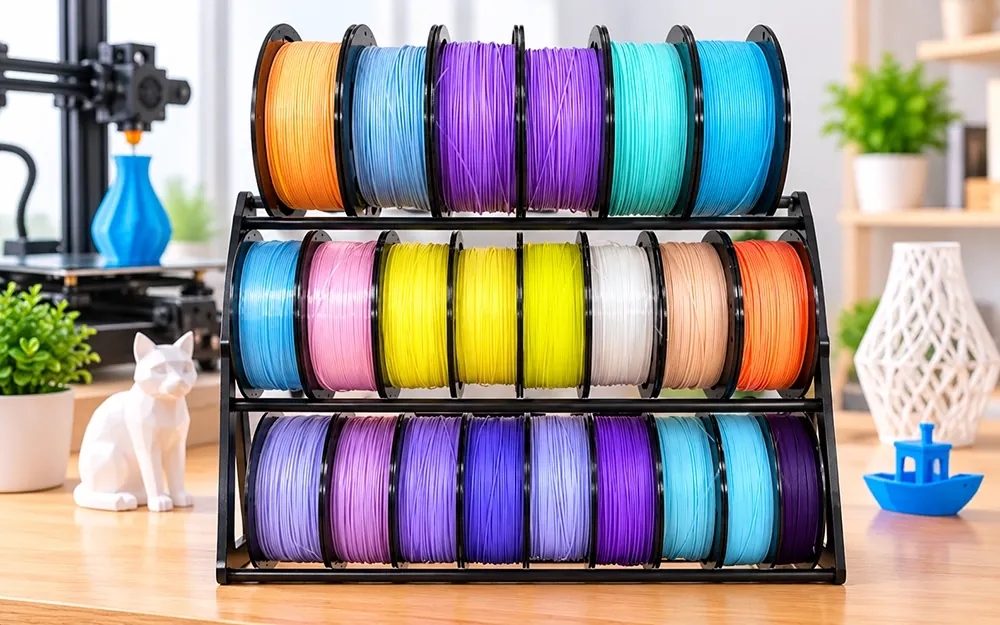
The best filament depends on the print. Choose PLA for display and prototypes, PETG for tougher functional parts, ASA for weather exposure and TPU for flexible parts. Before ordering, verify diameter, spool data, color and batch consistency.
Material comparison data
| Material | Density | Nozzle | Bed | Print speed | Key mechanical data | Data status |
|---|---|---|---|---|---|---|
| PLA | 1.25 ±0.05 g/cm³ | 195–230°C | 0–60°C | 40–60 mm/s | Tensile 60 MPa; Elongation 3.0%; Flexural 1,900 MPa | Complete |
| PETG | 1.27 g/cm³ | 220–250°C normal; 240–250°C high-speed | 60–80°C | 40–60 mm/s normal; 150–200 mm/s high-speed | Elongation 10%; Flexural 2,060–2,160 MPa | Partial |
| ABS | 1.04 ±0.5 g/cm³ as supplied | 230–250°C | 70–90°C | 30–50 mm/s | Tensile ≥43 MPa; Elongation ≥10.0%; Flexural ≥60 MPa | Partial / verify |
| TPU | Not supplied | 215–235°C | 0°C or 60–80°C | 20–40 mm/s | Not supplied | Partial |
Source: PIBUNO project material workbook and existing product templates. “Not supplied” means the project did not include a verified value; it is not an industry default.
A selection table beats a generic ranking
| Job | Start with | Why |
|---|---|---|
| Display model | PLA or effect PLA | Detail, color and easy printing |
| Indoor functional part | PETG or ABS | More toughness than standard PLA |
| Outdoor part | ASA | Better UV and weather resistance |
| Flexible grip | TPU | Bend and compression |
| High-temperature part | PC, PA, PEEK or PEI | Higher service temperature, with more process control |
| Stiff lightweight part | Carbon-fiber composite | Increased stiffness, with nozzle wear to consider |
The material should follow the use condition. “Best” without an application is mostly a brand preference.
Match the printer before the color
Check the maximum nozzle and bed temperature. Check whether the printer has an enclosure and whether the extruder can handle flexible filament. Use a hardened nozzle for abrasive composites.
A perfect material that the machine cannot process is not a good purchase.
Look at the whole spool
The filament is one part of the product. The spool and packaging affect handling, storage and repeat orders.
Check:
- Net filament weight
- Outer spool diameter and width
- Center hole
- Spool material
- Diameter tolerance
- Color reference
- Packaging and label
- Storage instructions
These details are especially important when a printer rack, dry box or automatic feeder has limited clearance.
Match the finish to the product
Silk PLA can make a decorative model stand out. Matte PLA can reduce glare and hide layer reflections. Clear PETG can suit light covers and translucent parts. Carbon-fiber blends create a technical surface and increase stiffness.
Order a physical sample when appearance drives the purchase. Photos can show a finish, but they do not show how the color changes under the customer's lighting.
Think about repeatability
The first spool can be excellent and the next batch can still vary. For commercial work, ask how the supplier controls color, diameter and raw-material batches.
Keep an approved sample and a written specification. A color name such as “navy” is not enough. The package label, reference chip and print test should agree.
Product families at a glance
The Pibuno product catalog provides material categories for general printing, engineering, flexible parts and visual effects.
Common starting points include:
- PLA for models and appearance
- PETG for tougher functional parts
- ABS and ASA for weather-exposed parts
- TPU for flexible parts
Buyers planning repeat production can review wholesale filament options.
Test the candidate material
Print a small part that represents the real geometry. Include a corner, thin wall, overhang, hole and attachment point.
Then:
- Measure critical dimensions.
- Check layer bonding.
- Apply the expected load.
- Expose it to the real heat or moisture condition.
- Compare the surface with the approved sample.
Keep the print profile with the test. A material can fail because the profile is wrong, and a price comparison cannot show that.
Cost should be measured per usable part
Two spools with different prices may print different numbers of usable parts. Failed prints, purge waste, support material, packaging and operator time all affect the real cost.
Use the finished-part test to compare. A lower-priced spool that fails often is not the cheaper option.
Common buying mistakes
Do not choose a material only because it has a high temperature rating. Check the strength, printability and printer requirements.
Do not compare spool prices without checking net weight. A larger gross package weight does not prove there is more filament.
Do not approve a color from a screen. Order a physical sample and inspect it in the final product lighting.
Start with the part failure you need to avoid
Filament selection becomes clearer when the failure is specific:
- The model needs sharper detail.
- A bracket bends under load.
- A cover deforms in heat.
- A fixture cracks after impact.
- A grip is too hard.
- A translucent window looks cloudy.
- A production print stops because the spool does not feed smoothly.
The right material and profile should address one of those conditions. A general preference for a brand or color is not enough for technical approval.
Printer and process fit
A material is only a candidate after the printer can process it. Check the hot-end temperature, bed range, enclosure, nozzle wear and feed system.
Flexible filament may require a direct-drive extruder and low speed. Abrasive composites may require a hardened nozzle. High-temperature polymers may need a heated chamber and drying equipment.
Ask whether the printer can hold the profile for the length of the job. A machine that reaches the start temperature but cannot maintain chamber conditions may not produce a repeatable part.
A simple qualification matrix
| Part requirement | Sample test | Record |
|---|---|---|
| Appearance | Visual and color comparison | Reference photo and physical sample |
| Dimensional fit | Measure holes and mating surfaces | Printer, material and profile |
| Impact | Drop or flex with expected load | Failure location and layer direction |
| Heat | Loaded exposure at service temperature | Time, temperature and deformation |
| Moisture | Dry and wet comparison | Drying process and surface result |
| Repeat supply | Second spool or lot | Color, diameter and test result |
The test should match the part. A flat material coupon does not prove a printed bracket will hold.
Spool consistency
The outside of a spool is easy to inspect. The first layers, middle of the spool and final meters are more informative for a production evaluation.
Check for tangles, diameter variation, joins, debris and a damaged filament end. Confirm that the spool fits the holder and dry box.
Ask how the supplier protects color and material identity through packing. A label that remains attached and readable after handling is part of the product.
Sampling before a larger order
Order enough material to print more than one test. A single short sample may hide a feed defect that appears late in the spool or a color difference between lots.
Use a written sample request:
- Material and grade
- Color reference
- Diameter
- Net weight
- Spool format
- Application
- Required evidence
- Acceptance test
This gives the supplier a clear target and gives the buyer a consistent basis for approval.
What not to infer from a product page
A page can show a beautiful model, a glossy finish and a material name. It does not prove that the same material fits the buyer's printer, layer height and load.
It also does not prove food-contact suitability, outdoor life, exact color under retail lighting or batch consistency. Ask for the relevant data and test the actual product.
The best article can narrow the field. It cannot replace a qualified sample.
Technical source note
Material property claims should be checked against the exact grade's technical data sheet. Printer limits should come from the printer and hot-end documentation. Keep the version of each source with the sample and production approval.
Package and color need a physical check
A beautiful coil photo does not show how the color looks after printing. Pigments, surface texture and lighting can shift the result.
Review a printed sample under daylight and the retail light used for the product. Compare it with the approved reference and check whether the spool label is readable.
Packaging should protect the reel in storage and shipping. For retail products, it also needs the required brand, material, color, weight and handling information.
Compare failure cost
The cheapest spool is not always the lowest-cost material. A blocked nozzle, tangled reel or variable color can stop a production run and create scrap.
Estimate the cost of:
- Failed parts
- Operator time
- Purge and support waste
- Re-slicing and re-testing
- Repacking
- Late delivery
Use the approved sample to compare suppliers on a good-part basis, not only on a per-kilogram price.
Keep a supplier review file
For a repeat order, retain the quotation, material specification, sample result, packaging proof and agreed delivery terms. Record who approved the sample and when.
If a material changes, the buyer should know whether the existing approval still applies. This is easier when the supplier and buyer use the same material and color identifiers.
Review the list before reordering
Before a repeat order, confirm the material name, color code, diameter, net weight, spool and packaging on the current quotation. Check that the approved sample still matches the specification.
Replace a supplier when repeated batches fail the agreed color, diameter or feeding test. A low unit price does not compensate for an unstable production input.
Keep the latest approved purchase specification visible to receiving and production so a routine reorder is checked against the right reference.
FAQ
What is the best filament for beginners?
PLA is often the easiest starting material. It is forgiving on many printers and available in many colors.
What is the strongest 3D printer filament?
Strength depends on the load. Carbon-fiber blends can be stiff, PC and nylon can be tough, and PEEK can handle high temperatures. The application decides which property matters.
Is expensive filament always better?
No. A well-controlled material that matches the application is more valuable than a premium material used outside its process window.
How can I compare suppliers?
Compare the actual grade, diameter tolerance, net weight, color control, test documentation, packaging and repeat-order process.