

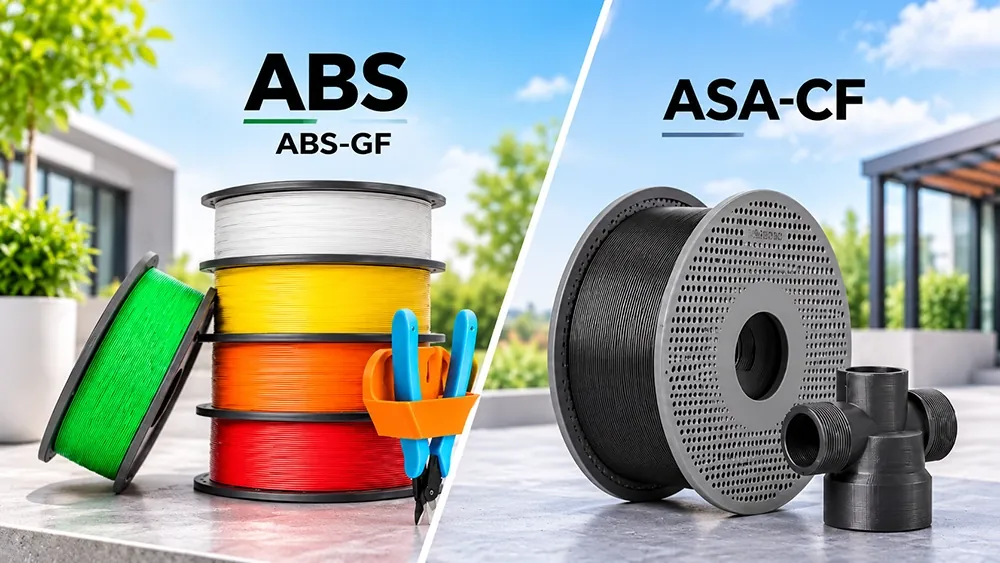
Start with ASA for parts exposed to sunlight and weather. ABS can work well for indoor durable parts and established workflows, but it generally offers less UV and weather resistance than ASA. The exact grade and print quality still matter.
Material comparison data
| Material | Diameter | Density | Nozzle | Bed | Print speed | Key mechanical data |
|---|---|---|---|---|---|---|
| ASA | Not supplied | Not supplied | Not supplied | Not supplied | Not supplied | Not supplied |
| ABS | 1.75 mm or 3.0 mm | 1.04 ±0.5 g/cm³ as supplied | 230–250°C | 70–90°C | 30–50 mm/s | Tensile ≥43 MPa; Elongation ≥10.0%; Flexural ≥60 MPa |
Source: PIBUNO project material workbook and existing product templates. “Not supplied” means the project did not include a verified value; it is not an industry default.
ASA vs ABS at a glance
| Factor | ABS | ASA |
|---|---|---|
| Typical use | Indoor fixtures, housings, prototypes | Outdoor covers, automotive-style parts, weather-exposed fixtures |
| UV resistance | Moderate | Better |
| Heat resistance | Good | Good, with grade-dependent differences |
| Impact resistance | Good | Good |
| Printing difficulty | Requires controlled cooling and often an enclosure | Similar to ABS, with careful temperature control |
| Fume and odor control | Ventilation required | Ventilation required |
Why ASA is usually the outdoor choice
Sunlight can change the color and surface of many plastics. ASA was developed with better weather resistance than ABS, so it is a practical starting point for parts that remain outside.
This does not mean every ASA part is permanent. Part thickness, color, surface finish, UV exposure, temperature and mechanical load all affect service life. A thin white sample and a thick black production part can age differently.
ABS remains useful indoors
ABS is a capable material for durable indoor parts. It has useful impact resistance and a familiar production base. It can be easier to source in established grades and familiar colors.
For an enclosure, jig or appliance component that stays out of sunlight, ABS may meet the requirement without the extra weather-oriented selection.
Printing differences
Both materials benefit from stable chamber conditions. Drafts and uneven cooling can cause warping. Large, flat parts need attention to bed adhesion and part orientation.
ASA often prints in a similar temperature range to ABS, but the exact profile changes by grade and printer. Start with the supplier's recommendation, then check layer bonding, corners and surface finish on a representative part.
Ventilation is important. The printing process can produce odors and emissions. Use an appropriate workspace and follow the equipment and material instructions.
Color matters
Dark colors absorb more heat in direct sunlight. Light colors may show dirt more readily. A customer may choose black ASA for appearance, then discover that the same geometry reaches a higher surface temperature in sunlight.
Approve a physical color sample under the intended lighting. For production, keep a reference part and a color standard.
When to choose ABS
Choose ABS when:
- The part is used indoors.
- The application needs a familiar durable plastic.
- The printer and workspace are set up for controlled ABS printing.
- Cost or available color range favors a proven grade.
When to choose ASA
Choose ASA when:
- The part will remain outdoors.
- UV and weather exposure are more important than the lowest material cost.
- The printer can handle the required process temperatures and controlled cooling.
- A sample can be tested in the real environment.
The Pibuno ABS and ASA range and product catalog show the available material families. For other engineering options, see the engineering filament category.
A practical test
Print the same bracket in both materials using the approved colors. Expose both samples for a defined period of sunlight and weather. Measure color change, warping and surface cracking. Flex or load the parts after exposure.
This test is more useful than a generic “outdoor rated” label. It connects the material to the actual geometry.
Common mistakes
Do not use PLA instead of ASA or ABS just because it prints more easily. PLA is useful, but it has lower heat resistance and may deform in a hot outdoor setting.
Do not assume all ABS or ASA grades are interchangeable. Additives and manufacturing differences can change impact, flow and weather behavior.
Do not approve color from a computer screen. A color chip under office light may look different from the same plastic under sunlight.
Separate heat ratings from real part performance
A material data sheet may report a heat-deflection temperature, a Vicat softening value or a maximum processing temperature. Those values do not describe one universal safe service temperature.
Heat deflection depends on the applied load. A free-standing decorative shape can survive a temperature that would make a loaded bracket creep.
For ASA and ABS, test the part at the highest expected surface temperature with the real load installed. A dark part in direct sun may run hotter than the air temperature around it.
Measure the part after cooling. Check screw holes, snap fits and flatness, not only whether the plastic visibly melted.
Build a repeatable printing profile
ASA and ABS can share a general process direction, but their best temperatures may differ by grade and color. Start with the supplier recommendation and print a small enclosure-like shape.
A useful test part has:
- A wide base
- One tall wall
- A short bridge
- Two screw holes
- A corner that can reveal lifting
Adjust chamber and cooling behavior before adding a large brim. A stable environment often helps more than pressing the first layer harder into the bed.
Record the nozzle, bed and chamber temperature, cooling level, flow and first-layer speed. Repeat the profile on a second print before production.
Weather testing for an outdoor bracket
Exterior performance cannot be proven by a single material name. Build a sample set with the final geometry, color and surface finish.
Expose an ASA sample and an ABS sample to the same sunlight and weather for a defined period. Keep a third sample indoors as a control.
Record:
- Date and location
- Mounting angle
- Direct-sun exposure
- Rain and temperature range
- Color reference
- Dimensional measurements
- Visible cracks or chalky surfaces
- Load or fit result
The test does not need to imitate years of service in a few days. It should still reveal obvious failures and produce a record that can support a more realistic outdoor validation plan.
Design for differential movement
Large plastic parts expand and contract as temperature changes. ASA and ABS are not equally stable in every geometry, and a dark color can increase surface heating.
Use slotted holes or controlled clearance where a part attaches to metal. Avoid trapping a plastic section between rigid surfaces with no room for movement.
Add radii where a corner carries a load. A thick block can warp while a thin rib may be too weak. Shelling a thick section may improve cooling and reduce material use.
Plan the full product, not only the filament
The finished part includes print orientation, inserts, fasteners, coatings and cleaning. A solvent or adhesive that suits ABS may affect ASA differently. A painted surface can change color and UV behavior.
Test the complete assembly before approving the material. For repeat production, keep the material, color, profile and finishing record together.
Technical source note
Use the exact material supplier's current technical data sheet for nozzle range, drying, mechanical properties and heat data. Record the document version and the tested material state. Do not convert a data-sheet value into a Pibuno product guarantee.
Assemble and finish the sample correctly
An ASA or ABS test part can fail during assembly even when the print looks good. Thread-forming screws may split a thin boss, and repeated tightening can soften or crack the plastic.
Use the planned insert or fastener in the sample. If a metal insert is required, test the installation temperature and pull-out behavior on the actual material.
Adhesives and paints need their own compatibility check. A solvent that works on one grade may leave a weak or discolored surface on another.
Protect identity through production
ASA and ABS can look similar in a completed part. Label the spool, retain the box or material certificate and keep the print profile with the approved sample.
When a warehouse stores both materials, separate bins reduce accidental mixing. Operator training should include the difference between the materials, the target color and the approved application.
At receiving, inspect the spool and packaging for damage. A crushed reel or exposed filament can affect feeding even when the polymer is correct.
A decision record for the buyer
Write a short approval note that states:
- Material and grade
- Color reference
- Part geometry and orientation
- Printer and profile
- Outdoor or indoor exposure
- Test result and date
- Approved sample location
That record is more useful than a generic statement that ASA is “better outdoors.” It shows why the selected part is acceptable for its actual service condition.
Recheck the same geometry after aging
Measure the mounting holes, flatness and load points again after the weather test. A part can keep its color while losing fit through creep or warpage.
Repeat the test with the planned fastener and surface finish when either changes. The outdoor result belongs to the complete assembly.
FAQ
Is ASA stronger than ABS?
Neither is universally stronger. Both can provide good impact and heat performance. ASA is generally preferred when outdoor UV exposure is important.
Does ASA need an enclosure?
Many printers benefit from an enclosure for large ASA parts because it reduces drafts and helps control warping. Follow the printer and filament recommendations.
Can ABS be used outdoors?
ABS can be used outdoors in some conditions, but it generally offers less UV and weather resistance than ASA. The application and desired service life should guide the decision.
Are ASA and ABS fumes safe?
Both can produce odors and emissions during printing. Use proper ventilation, follow equipment instructions and avoid assuming a material is harmless because it is sold for 3D printing.