

There is no single best filament type. Start with the job: PLA suits detailed indoor parts, PETG balances toughness and clarity, ABS and ASA handle tougher service conditions, and TPU covers flexible parts. Specialty blends are useful only after the base material and printer requirements make sense.
Material comparison data
| Material | Density | Nozzle | Bed | Print speed | Key mechanical data | Data status |
|---|---|---|---|---|---|---|
| PLA | 1.25 ±0.05 g/cm³ | 195–230°C | 0–60°C | 40–60 mm/s | Tensile 60 MPa; Elongation 3.0%; Flexural 1,900 MPa | Complete |
| PETG | 1.27 g/cm³ | 220–250°C normal; 240–250°C high-speed | 60–80°C | 40–60 mm/s normal; 150–200 mm/s high-speed | Elongation 10%; Flexural 2,060–2,160 MPa | Partial |
| ABS | 1.04 ±0.5 g/cm³ as supplied | 230–250°C | 70–90°C | 30–50 mm/s | Tensile ≥43 MPa; Elongation ≥10.0%; Flexural ≥60 MPa | Partial / verify |
| TPU | Not supplied | 215–235°C | 0°C or 60–80°C | 20–40 mm/s | Not supplied | Partial |
| PC | Not supplied | 250–280°C | 100–120°C | Not supplied | Not supplied | Partial |
Source: PIBUNO project material workbook and existing product templates. “Not supplied” means the project did not include a verified value; it is not an industry default.
Filament types by use case
| Use case | Good starting materials | Main check |
|---|---|---|
| Models and display pieces | PLA, silk PLA, matte PLA | Heat exposure and surface finish |
| Tough indoor parts | PETG, ABS | Impact load and dimensional accuracy |
| Outdoor parts | ASA | UV and weather exposure |
| Flexible parts | TPU | Shore hardness and extruder setup |
| High-temperature parts | PC, PA, PEEK, PEI | Printer chamber and process control |
| Stiff lightweight parts | Carbon-fiber or glass-fiber blends | Base resin and nozzle wear |
| Decorative effects | Silk, matte, rainbow, wood, marble, glow | Color program and print profile |
Everyday materials
PLA
PLA is easy to print and holds detail well. It fits models, prototypes, signs and many consumer products that stay indoors. Standard PLA is not the first choice for hot or highly stressed parts.
Pibuno's PLA filament category includes standard, high-speed and visual-effect options. The category is the right starting point when the buyer needs to browse colors and finishes rather than read a basic definition.
PLA+
PLA+ generally describes a modified PLA with improved toughness or processing behavior. The formulation varies by supplier. Ask what changed instead of assuming every PLA+ product has the same properties.
PETG
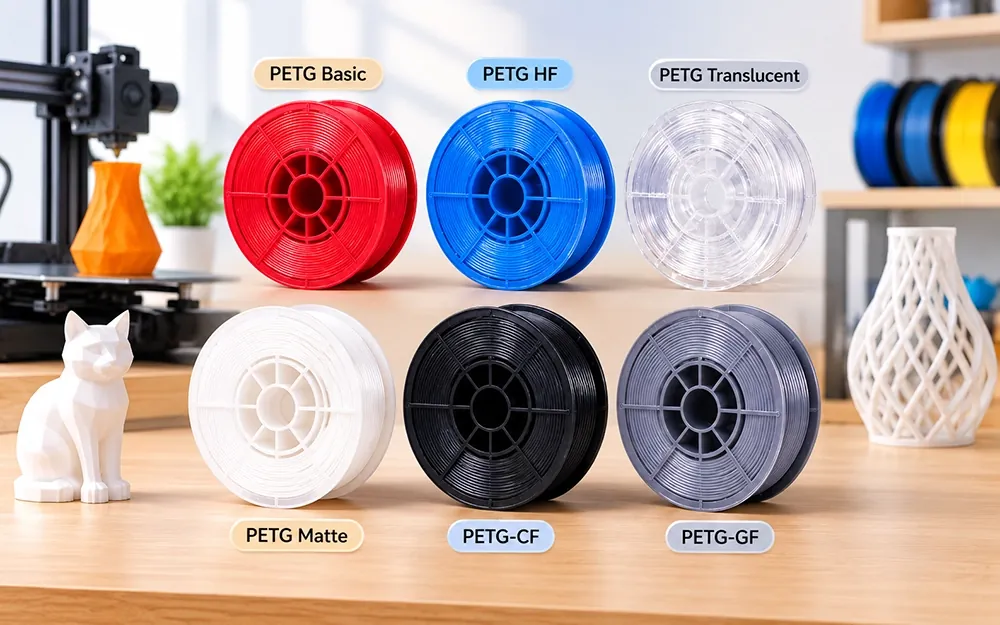
PETG filament balances moderate toughness, heat resistance and translucency. It is a practical choice for brackets, housings, guards and clear covers when the printer can control stringing and bed adhesion.
Engineering materials
ABS
ABS is tough and can handle more heat than standard PLA. It often needs an enclosure and controlled cooling to limit warping. Ventilation is important because the printing process produces fumes and odors.
ASA
ASA is similar to ABS in many workflows but is usually chosen for better weather and UV resistance. For fixtures, covers and parts used outdoors, compare the exact grade instead of relying on a broad material label.
Polycarbonate
PC offers high impact strength and heat resistance. It usually needs a capable hot end, strong bed adhesion control and a controlled chamber.
Nylon
Nylon is tough and wear-resistant but absorbs moisture quickly. Drying and dry storage are part of the material specification, not optional maintenance.
PEEK and PEI
PEEK and PEI are high-performance materials for demanding engineering work. They require high temperatures, controlled processing and a clear application reason. They are not everyday substitutes for PLA or PETG.
Flexible material
TPU filament bends and compresses. It is used for grips, seals, straps and protective parts. A direct-drive extruder and a short filament path usually improve control.
Shore hardness is a starting point. Two TPU products with the same hardness can still differ in rebound, tear resistance and print speed.
Reinforced materials
Carbon-fiber and glass-fiber blends are composites. The base resin controls much of the heat and impact behavior. The fibers increase stiffness and can improve dimensional stability, but they also wear nozzles and change flow.
For these products, confirm:
- Fiber type and loading
- Base polymer
- Nozzle material
- Recommended layer height and flow
- Part orientation and support requirements
Visual-effect materials
Silk PLA creates a reflective surface. Matte PLA reduces glare. Rainbow filament changes color along the print. Wood and marble styles imitate natural surfaces.
Effect materials sell the appearance, so samples matter. Lighting, layer height and print orientation can make the same color look different. Review a printed sample rather than judging from a spool photo.
How to choose without overbuying
Start with one required property. If the part must survive heat, do not choose a material only because it prints easily. If the part is a display model, do not pay for a high-temperature polymer that adds process risk without adding value.
Then confirm printer limits:
- Nozzle and bed temperature
- Enclosure requirements
- Extruder grip for flexible filament
- Hardened nozzle for abrasive blends
- Bed surface and adhesion control
The Pibuno product catalog groups these options by material, performance and finish so the selection stays tied to a real application.
Strength, stiffness and toughness are different
A part can be stiff without being tough. It can resist a slow load without surviving a sharp impact. These properties lead to different filament choices.
PLA is often stiff. Carbon-fiber blends can increase stiffness further. Nylon and polycarbonate may offer useful impact performance with a different balance of heat and moisture sensitivity.
TPU is flexible by design. Using Shore hardness alone does not predict tear resistance or rebound.
Write the actual failure condition before selecting a material:
- Excessive bending
- Cracking after impact
- Deformation in heat
- Layer separation
- Surface wear
- Color fading
The material and print direction should address that condition. A generic “strongest” ranking cannot.
A printer capability matrix
The printer may decide the material before the application does.
| Printer capability | Materials that commonly fit | Main limitation |
|---|---|---|
| Open printer, standard hot end | PLA, some PETG | Heat, fumes and chamber control |
| Enclosed printer | ABS, ASA, some PC | Process profile and ventilation |
| Direct-drive extruder | TPU and flexible blends | Speed and retraction limits |
| Hardened nozzle | Carbon-fiber and glass-fiber blends | Abrasion and flow control |
| High-temperature hot end and chamber | PC, PEEK, PEI | Drying, thermal treatment and equipment control |
Check the complete system. A hot end that reaches the temperature does not guarantee that the bed, chamber, feeder and cooling system can support the material.
Color and finish are material decisions
A color chip does not tell you how a printed surface will reflect light. The same pigment can look different on a matte shell, a glossy silk model or a thin translucent part.
Layer height and print direction also affect the appearance. Silk finishes can amplify reflections, while matte finishes can soften them. Clear materials scatter light at layer boundaries.
Approve a printed sample under the light where the product will be seen. Record the material, color, layer height and surface orientation.
How to evaluate a new material
Start with a small qualification set:
- Print a first-layer patch.
- Print a temperature tower if the supplier range needs tuning.
- Print a short dimensional coupon with a hole and thin wall.
- Print a representative production geometry.
- Measure critical features.
- Apply the real load, heat or moisture condition.
Do not stop after one attractive test print. Check whether the result repeats on the next spool or the next operator.
What to record for a repeat order
For each approved material, keep:
- Material family and grade
- Color reference
- Diameter and tolerance
- Net weight and spool format
- Printer, nozzle and profile
- Drying method
- Test sample and result
- Supplier and lot information
This record prevents a product change from being approved only because two photos look similar.
Test the actual lot
A qualification result belongs to the material, color, profile and spool that produced it. If the supplier changes the colorant, diameter process or base grade, repeat the small dimensional and functional test.
Keep one retained sample and the corresponding print file. A future operator can then compare a new lot against a physical result instead of relying on memory or an old message.
Shrinkage and fit
Every filament type can produce a slightly different finished dimension. Polymer shrinkage, cooling rate, flow and the printer's calibration all affect the result.
The common material label is not a tolerance specification. Print holes, walls and mating surfaces from the final geometry, let the part cool and measure it before scaling the model.
For a snap fit, thread insert or enclosure joint, test the complete assembly. A material that looks dimensionally consistent by itself may still change the clearance when another part is pressed into it.
Record compensation values in the approved profile. Do not carry a compensation setting from one material to another without a test.
Product-page versus article intent
An article should answer “which type fits this job?” A product category should show available materials, colors, spools and purchasing details.
Do not repeat the entire catalog in the article. Link to the category when the reader needs the next step. Clear PLA, PETG, TPU and engineering categories help readers continue without turning the guide into a sales page.
Common mistakes
One mistake is treating “strong” as a single property. Impact strength, stiffness, layer adhesion and heat resistance are different measures.
Another is ordering a specialty material before checking the printer. A material that needs 350 C cannot be used reliably on a hot end limited to 260 C.
The final mistake is ignoring moisture. Nylon, TPU and some reinforced materials may need drying before the first print.
FAQ
What is the most common 3D printer filament?
PLA is the most common starting material for consumer and educational FDM printing because it is easy to handle and available in many colors.
What filament is best for functional parts?
PETG, ABS, ASA, PC and nylon can all fit functional work. The right one depends on heat, impact, weather and printer capability.
Are exotic filaments worth buying?
They are worth it when they solve a specific need. A visual-effect filament can support a premium product, and a reinforced grade can improve a structural part. Neither is automatically better for every print.
Can different filament types share one print profile?
No. Base material, color, additives and manufacturer formulation all affect the profile. Start with the spool recommendation and test before production.