

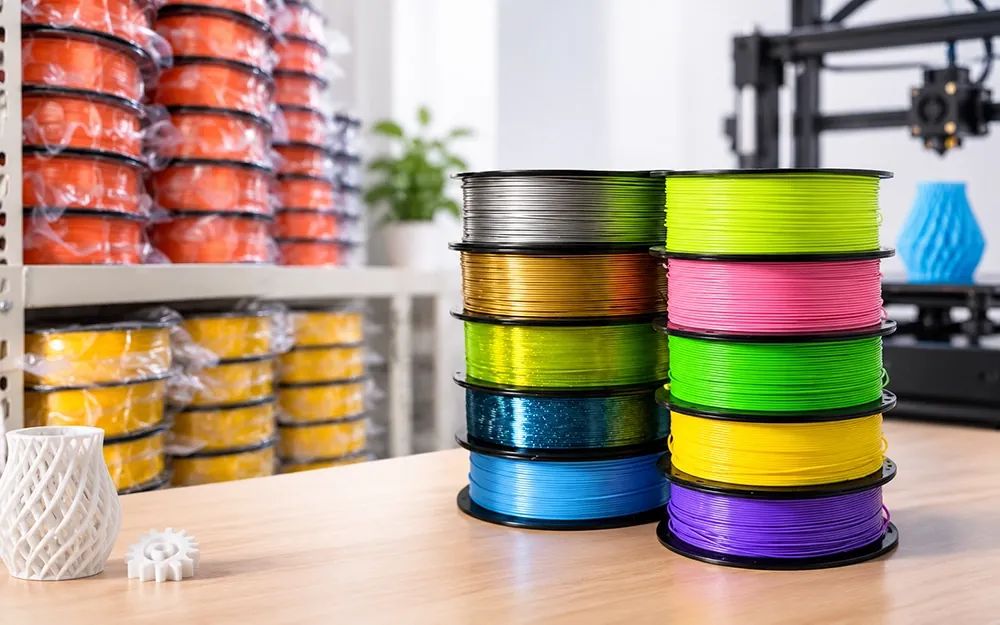
3D printer filament is the plastic feedstock an FDM printer melts and lays down layer by layer. The finished material is only part of the decision. Print temperature, strength, heat exposure, flexibility, surface finish, spool size and printer setup all affect whether a filament works for the job.
Material comparison data
| Material | Density | Nozzle | Bed | Print speed | Key mechanical data | Data status |
|---|---|---|---|---|---|---|
| PLA | 1.25 ±0.05 g/cm³ | 195–230°C | 0–60°C | 40–60 mm/s | Tensile 60 MPa; Elongation 3.0%; Flexural 1,900 MPa | Complete |
| PETG | 1.27 g/cm³ | 220–250°C normal; 240–250°C high-speed | 60–80°C | 40–60 mm/s normal; 150–200 mm/s high-speed | Elongation 10%; Flexural 2,060–2,160 MPa | Partial |
| ABS | 1.04 ±0.5 g/cm³ as supplied | 230–250°C | 70–90°C | 30–50 mm/s | Tensile ≥43 MPa; Elongation ≥10.0%; Flexural ≥60 MPa | Partial / verify |
| TPU | Not supplied | 215–235°C | 0°C or 60–80°C | 20–40 mm/s | Not supplied | Partial |
Source: PIBUNO project material workbook and existing product templates. “Not supplied” means the project did not include a verified value; it is not an industry default.
What FDM printing does with filament
FDM stands for fused deposition modeling. A printer pulls a thin strand of filament from a spool, pushes it through a hot nozzle and deposits the softened plastic along a planned path. Each pass creates one layer. The layers bond as they cool and form the finished part.
The diameter is usually 1.75 mm for current desktop printers. Filament is sold by net weight, commonly 1 kg per spool. A 3 kg or 5 kg reel may be available for production work where fewer spool changes matter.
Filament is not ink. It becomes the structure of the part, so its properties stay with the finished object.
The main filament families
PLA
PLA is the usual starting point for models, prototypes, signs and decorative products. It is easy to print on most open printers and holds fine detail well. Standard PLA is less suited to hot cars, strong outdoor exposure or parts that need to flex.
Pibuno's PLA filament range includes standard colors and effect styles such as silk, matte and rainbow. The right sub-type depends on whether the customer cares more about detail, gloss, texture or production speed.
PETG
PETG filament usually offers more toughness and moderate heat resistance than standard PLA. It can also produce clear or translucent parts. PETG often needs more careful nozzle clearance and cooling control because it can stick too strongly to a smooth bed or form strings.
ABS and ASA
ABS is a familiar engineering plastic with good impact resistance. ASA is often chosen for outdoor parts because it handles sunlight and weather better. Both generally need more controlled printing conditions than PLA, especially around cooling, enclosure temperature and fumes.
TPU
TPU filament is flexible. It suits grips, straps, bumpers and parts that need to bend or absorb impact. Shore hardness describes how soft the material feels, but the full formulation also affects rebound and tear resistance.
Reinforced and specialty materials
Carbon-fiber and glass-fiber blends add stiffness. PC, nylon, PEEK and PEI cover applications that need more heat, chemical resistance or mechanical performance. These materials usually require more capable printers and closer process control.
Match the material to the part
| Requirement | Practical starting point |
|---|---|
| Display model or detailed prototype | PLA |
| Tougher indoor bracket | PETG or ABS |
| Outdoor cover or fixture | ASA |
| Flexible grip or bumper | TPU |
| Stiffer lightweight part | Carbon-fiber blend, with the base resin selected for heat and impact |
| High-temperature engineering part | PC, PA, PEEK or PEI, after checking printer capability |
Start with the hardest requirement. If a part must survive heat, sunlight or repeated impact, appearance alone should not decide the material.
The 3D printer filament types guide gives a broader comparison of the material families.
Check the full filament specification
A product name such as “PLA” or “PETG” is not a complete specification. Before ordering a production quantity, confirm:
- Base material and available grade
- Actual diameter and tolerance
- Net weight instead of gross shipping weight
- Spool material and dimensions
- Color reference or physical sample
- Recommended nozzle and bed range
- Drying requirements
- Packaging and label standard
For repeat orders, batch consistency matters as much as the first sample. A color may look right in one lighting condition and less consistent under retail lighting. A spool may fit one printer and rub against another.
Pibuno's product catalog groups materials by type, performance and visual effect. It is a useful place to compare general families before requesting an exact specification.
Common mistakes
The first mistake is choosing by color alone. Colorants and additives can change flow and print behavior.
The second is copying temperatures from another spool. Use the maker's range as a starting point, then run a small test on the actual printer.
The third is treating net weight as total package weight. A “1 kg spool” should mean 1 kg of filament unless the seller says otherwise.
The fourth is ignoring moisture. Nylon, TPU and some PETG grades can print poorly after absorbing water. Dry storage matters even when the defect looks like a temperature problem.
How much filament will a part use?
Slicer estimates are usually good enough to plan a first print. They are less reliable for repeat production if the model, nozzle, infill or support settings change.
Weigh a representative finished part and its support material after a test run. Use that result to estimate a batch, then add a sensible allowance for failed starts and purge waste. This is more useful than estimating from model volume alone.
Why diameter and tolerance matter
Most desktop FDM systems feed 1.75 mm filament, but the important number is not just the nominal diameter. The strand must stay within a controlled range along the spool and around its cross-section.
If the filament is too thick in one section, the extruder may grind it or struggle to maintain flow. If it is too thin, the extruder can slip and the slicer can under-extrude because the commanded volume assumes more plastic than the hot end receives.
Diameter variation becomes more noticeable on long prints and fast printers. A spool can pass a short test and still show inconsistent walls when the production order runs for hours.
Ask the supplier for the nominal diameter, tolerance and inspection method. A line that says “1.75 mm” without a tolerance is only half of the specification.
The spool is part of the printer interface
Filament does not move through an ideal straight line. It leaves a reel, passes a holder, bends through a guide and enters the extruder. The spool width, outer diameter, center hole and winding pattern can all affect feeding.
A reel that fits one printer may hit the frame of another. A heavy 5 kg spool can overload a holder designed for 1 kg. A cardboard spool may be acceptable on a roller but wear unevenly on a small axle.
For print farms, define the complete handling system:
- Reel dimensions and weight
- Holder clearance
- Required center-hole size
- Feed angle
- Dry-box compatibility
- End-of-spool attachment method
- Label position for quick material identification
These practical details prevent a material change from becoming a mechanical interruption.
Moisture control belongs in the selection
Some filaments are more sensitive to moisture than others, but water can affect nearly any FDM material after enough exposure. PETG and TPU can produce popping, surface roughness and inconsistent extrusion. Nylon can absorb water quickly.
The material specification should say whether drying is recommended before use. Store opened spools in a sealed container with desiccant and a humidity indicator.
Do not diagnose every print defect as wet filament. Check the nozzle, first layer and slicer profile first. When moisture is a reasonable suspect, dry the spool within the supplier's temperature range and repeat the same test part.
What a useful filament data sheet includes
A product page is useful for color and packaging, but a production buyer needs more. Look for:
- Base polymer and grade
- Colorant or effect description
- Nominal diameter and tolerance
- Net weight
- Recommended nozzle and bed range
- Drying conditions
- Mechanical property notes with test conditions
- Recommended storage
- Spool dimensions and material
Material properties are not interchangeable unless the grade and test condition match. A tensile value from one PLA grade does not establish the behavior of every silk or matte PLA product.
How to qualify a spool
Begin with a small test matrix rather than a full production part. Print a first-layer patch, a short temperature tower and a small geometry with a hole, overhang and thin wall.
For each sample, record:
- Material and color
- Spool or lot identifier
- Printer and nozzle size
- Nozzle, bed and chamber temperature
- Flow and speed
- Test result and observed defect
Then print the actual product geometry. Measure critical features and test the load or environmental condition the part will see.
Match material to the decision
The material selection should change when the requirement changes. A display model, an outdoor fixture and a flexible grip do not need the same plastic.
| Decision question | Evidence to collect |
|---|---|
| Will the part stay indoors? | Heat exposure, sunlight and surface expectation |
| Does it need flexibility? | Bend, compression, grip and recovery requirement |
| Is impact likely? | Drop or collision condition and failure mode |
| Does color sell the product? | Physical sample under final lighting |
| Will the part be produced repeatedly? | Spool handling, batch consistency and approved profile |
The answer should be useful before the reader reaches a product page. Product links help with the next step, but they cannot replace the technical explanation.
Filament in a production workflow
For repeat production, the spool is a controlled input. The operator should know which approved material, color, spool format and print profile belong to the job.
When a supplier changes the formula or packaging, the buyer should reassess the profile and finished-part result. A color that looks close but prints differently is still a material change.
This is why small samples and retained reference parts matter. They give the next order something concrete to compare against besides a photo.
FAQ
Is 1.75 mm filament universal?
Most current desktop printers use 1.75 mm filament, but confirm the printer specification. The filament diameter and tolerance still need to match the hot end and extruder.
Is a more expensive filament always better?
No. The right choice depends on the application. A well-controlled standard PLA can be better than an engineering material that the printer cannot process reliably.
Can one filament cover every product?
No. A material chosen for clear display pieces may fail an outdoor bracket. A flexible grip needs a different material from a dimensionally stable enclosure.
Does color affect printing?
Color and additives can affect flow and surface appearance. White may hide layer lines differently from black, and some pigments influence how the material melts. Test the exact color when appearance is critical.